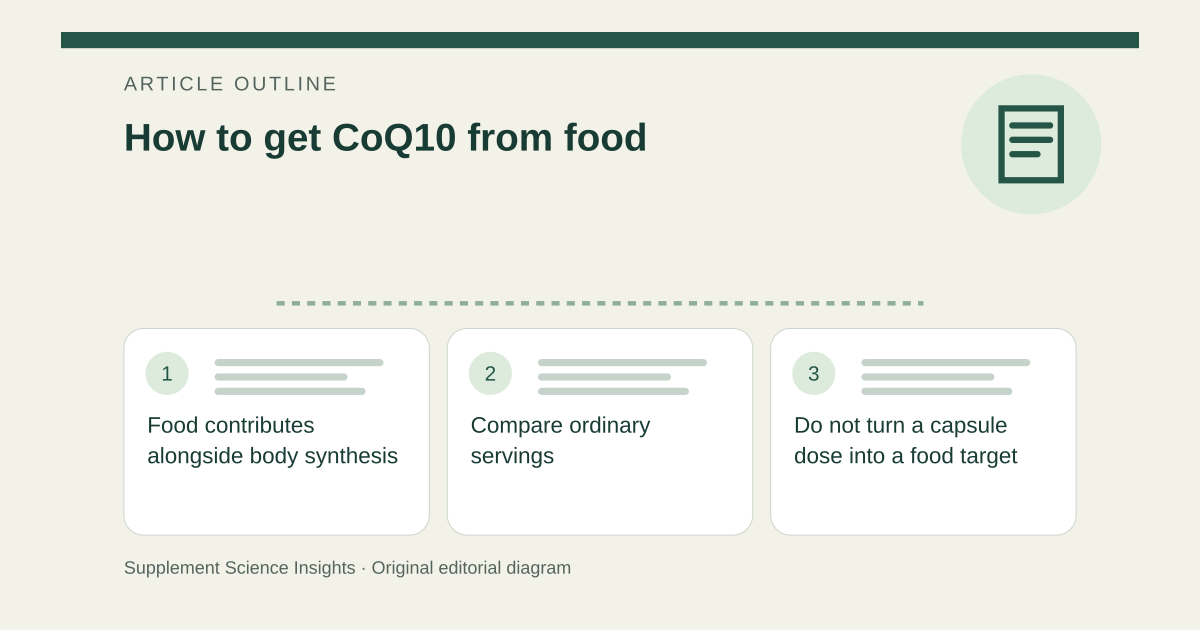
Food contributes alongside body synthesis
The Linus Pauling Institute identifies meat, poultry and fish as major dietary sources, with some oils, nuts and seeds also contributing. The body makes CoQ10 too. There is no established dietary intake recommendation that everyone must reach with food or capsules. [1]
Compare ordinary servings
Its food table lists about 2.6 mg in three ounces of fried beef, 2.3 mg in three ounces of marinated herring and 0.8 mg in one ounce of roasted peanuts. These are representative composition values, not promises for every preparation or instructions to favor frying. [1]
Do not turn a capsule dose into a food target
Imagine seeing 100 mg on a supplement label and trying to match it by eating very large servings. That is not a nutritional requirement. Choose foods for their overall dietary role; a clinician-directed supplement question has a different purpose from ordinary food intake. [1][2]
| Situation | Interpretation |
|---|---|
| Fish or meat | Provides some dietary CoQ10 |
| Nuts and oils | Also contribute |
| 100 mg capsule | Not a daily food requirement |
Sources for this article
- Coenzyme Q10 | Linus Pauling Institute | Oregon State University
Source consulted: 2026-09-20. This is a reference resource, not a claim that we conducted the studies or tested a product. - Dietary Supplements: What You Need to Know
Source consulted: 2026-09-20. This is a reference resource, not a claim that we conducted the studies or tested a product.