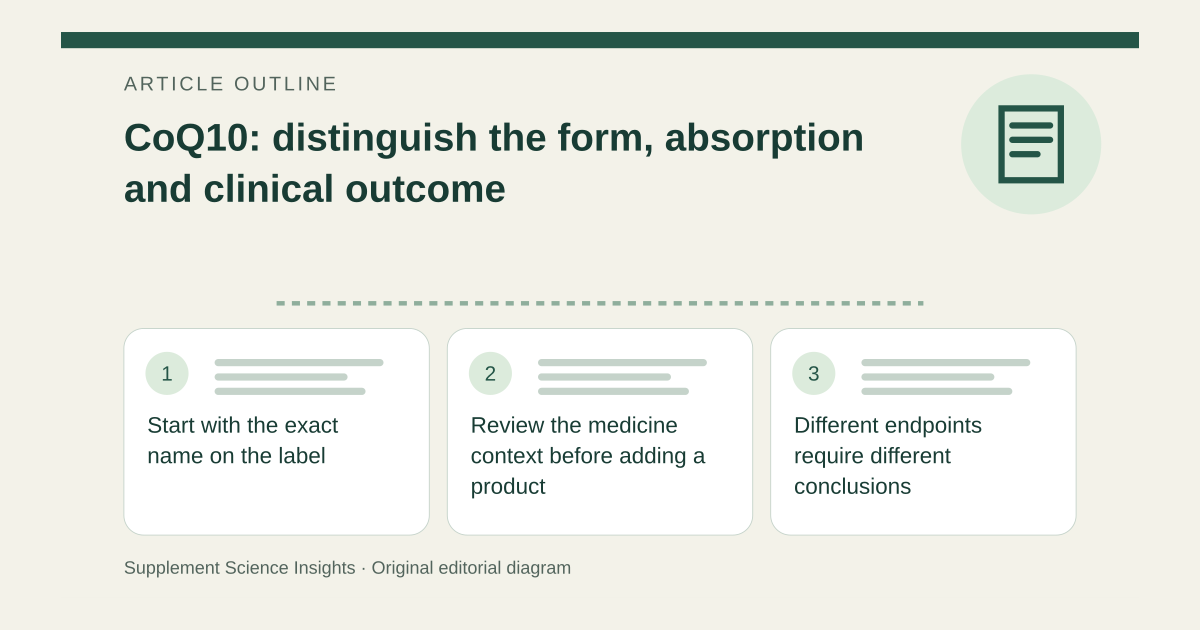
Start with the exact name on the label
Coenzyme Q10, often shortened to CoQ10, occurs naturally in the body. The NCI dictionary includes ubiquinone among its names. The National Library of Medicine identifies ubiquinol-10 as the reduced form of CoQ10; this chemical distinction is not itself a clinical ranking. [1][2][3]
Copy the stated form, amount, serving size and other ingredients together. If a product title says only CoQ10, do not silently fill in a more specific preparation from a different package or an advertisement for another strength. [1][2][3]
Review the medicine context before adding a product
NCCIH notes possible interactions with warfarin and insulin and potential incompatibility with some cancer treatments. Digestive upset or insomnia can occur. Bring the exact preparation to a clinician or pharmacist when reviewing suitability. [1]
Do not change a prescribed medicine or cancer treatment because a supplement is described as naturally occurring. An ingredient’s presence in the body does not answer how an added preparation fits an individual treatment plan. [1]
Different endpoints require different conclusions
Imagine an invented study reports a higher blood CoQ10 concentration after Form A than after Form B. That observation would address a concentration endpoint under the study conditions. It would not, by itself, establish fewer symptoms, better function or fewer hospital visits.
The comparison table separates the hypothetical measurement from the outcomes it leaves unanswered. No actual form superiority or health benefit is reported here. A higher measured concentration is not a substitute for studying the outcome a reader cares about.
| Measurement or conclusion | What the invented study establishes |
|---|---|
| Blood concentration differs between forms | A concentration difference under the studied conditions |
| Symptoms or physical function improve | Not established by concentration alone |
| Fewer hospital visits | Not established by concentration alone |
| Personal product or dose choice | Not supplied |
Keep the study population attached to the claim
A trial in people with a particular diagnosis, background treatment and baseline status answers a narrower question than whether all adults should take CoQ10. Record those features before comparing the findings with a retail claim.
Also distinguish an observational association from an intervention result. A lower measured level in a disease group does not show that raising the level with a supplement improves the disease. The proposed intervention must be evaluated directly.
Make a comparison that another reader can check
For each product, retain the complete label, named form, declared quantity and serving definition. For each supporting study, record the preparation, comparator, population, duration and main outcome. Put unknown fields in a separate column.
If the product and study do not match, identify the mismatch instead of assigning a numerical potency multiplier. A change in the carrier, combination ingredients or population can leave the advertised conclusion unresolved.
This page does not resolve disease-specific efficacy
The example illustrates an endpoint mismatch, not a clinical comparison of ubiquinone and ubiquinol. It supplies no dose, treatment protocol or advice to replace prescribed therapy.
The NCCIH page was last updated in January 2019 and inspected in September 2026. It supports the cited background and interaction cautions; this article does not treat it as a current systematic review of every CoQ10 indication. Independent scientific and editorial acceptance remains pending.
Sources for this article
- NIH NCCIH — Coenzyme Q10
Source consulted: 2026-09-17. This is a reference resource, not a claim that we conducted the studies or tested a product. - NCI Dictionary — Coenzyme Q10
Source consulted: 2026-09-17. This is a reference resource, not a claim that we conducted the studies or tested a product. - National Library of Medicine MeSH — Ubiquinol-10
Source consulted: 2026-09-17. This is a reference resource, not a claim that we conducted the studies or tested a product.
Considering a supplement?
Ingredient evidence alone does not establish which retail product is suitable. The featured option illustrates the label and formulation context above; it is not a clinical efficacy ranking.
Compare coq10 formulations (retail checks pending) → No overall winner
Compare formulations → · How we select products