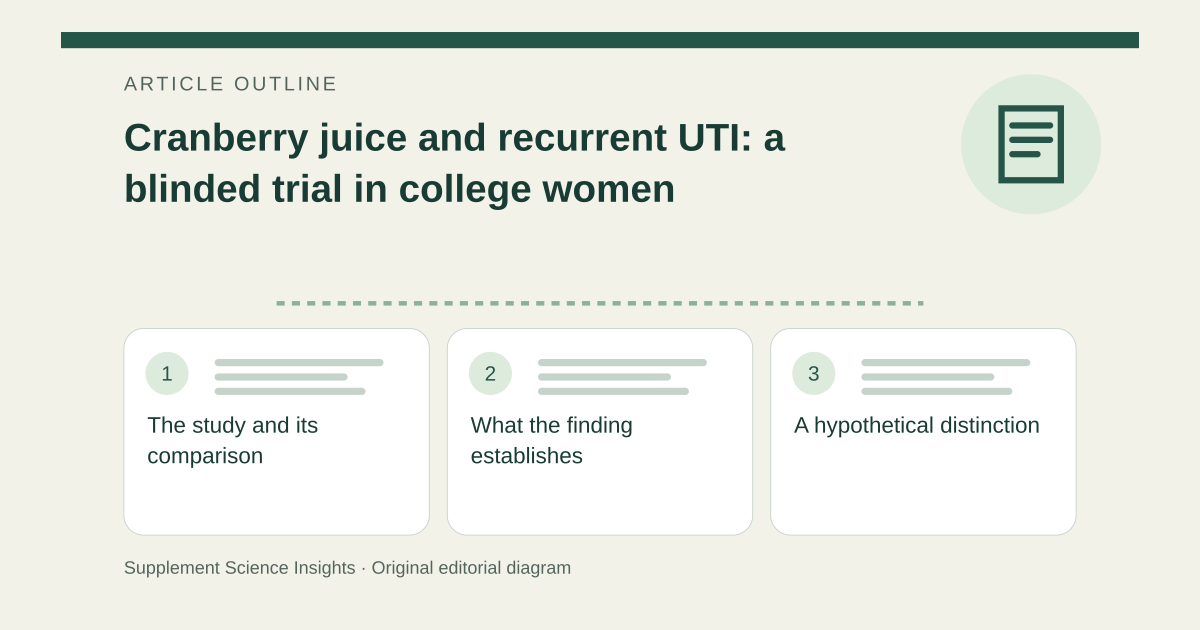
The study and its comparison
A blinded trial enrolled 319 college women presenting with an acute urinary tract infection. Researchers compared cranberry juice with a placebo beverage and followed participants until recurrence or six months. [1]
A recurrence required both symptoms and a positive urine culture. Recurrence occurred in about twenty percent with cranberry and fourteen percent with placebo; the trial did not demonstrate a reduction. Overall recurrence was lower than assumed in the original power calculation. [1]
What the finding establishes
A negative result for this population and beverage does not settle every cranberry preparation or prevention setting. Lower-than-expected events also limit precision. Funding and conflicts were not established from the abstract. The study concerns prevention after an infection, not treatment of an active infection or a reason to delay clinical care. [1]
A hypothetical distinction
Imagine a trial expects many more recurrences than occur. Its ability to distinguish treatments can be weaker than planned.
| Detail | Interpretation |
|---|---|
| Measured outcome | Keep the endpoint specific |
| Study preparation | Not every retail product |
| Remaining uncertainty | Not resolved by a mechanism |
Sources for this article
- Cranberry juice fails to prevent recurrent urinary tract infection: results from a randomized placebo-controlled trial.
Source consulted: 2026-09-19. This is a reference resource, not a claim that we conducted the studies or tested a product.