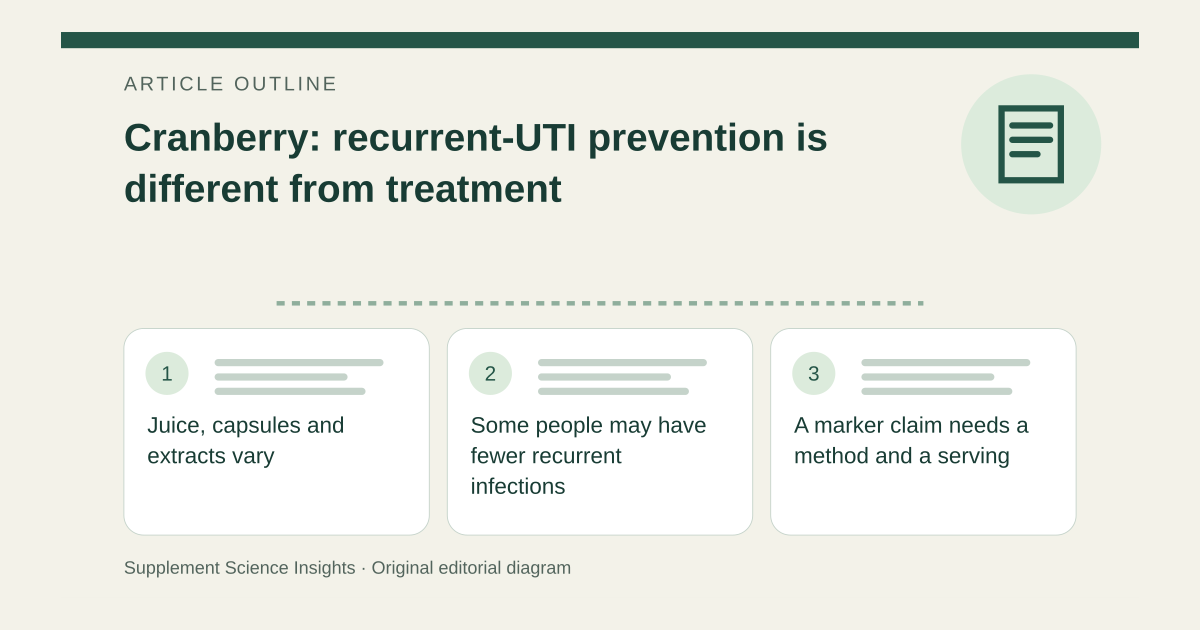
Juice, capsules and extracts vary
Cranberry products differ in juice content, extract composition and proanthocyanidin declarations. These compounds are often abbreviated PACs and are studied in relation to bacterial attachment. A mechanistic explanation does not establish that every cranberry product has the same preventive effect. [1]
The relevant comparison begins with the preparation used in the evidence. A large cranberry-equivalent number on a capsule is not automatically a measured PAC amount. [1]
Some people may have fewer recurrent infections
NCCIH describes evidence that cranberry may reduce symptomatic recurrent urinary-tract infections in some women, while noting inconsistent findings and differences among populations and products. Results in one group should not be generalized to every person at risk of infection. [1]
Prevention is the key distinction. Cranberry is not recommended as treatment for an existing UTI. A study of recurrence over months cannot establish that taking a product now will clear an infection causing current symptoms. [1]
A marker claim needs a method and a serving
Processing can affect composition. If a product declares PACs, retain the assay method, serving size and amount instead of comparing headline numbers alone. Different analytical methods may not produce interchangeable values.
The same principle applies to juice products: serving volume and actual cranberry content matter. A sweetened mixed-fruit drink and an extract capsule cannot be compared solely by price or by a photograph of cranberries on the package.
Recurrence should be defined consistently when comparing studies. Self-reported urinary discomfort and a confirmed infection are different endpoints, and changing that definition can change the apparent success of a prevention strategy.
Do not delay assessment of symptoms
People who suspect a UTI should seek diagnosis and appropriate treatment. Cranberry should not replace a proven treatment. Large amounts can cause digestive upset, and evidence about interaction with warfarin is conflicting rather than a reliable all-clear. [1]
Discuss a planned supplement with the care team when medicines, pregnancy or recurrent infections are involved. A recurrence-prevention plan may need information about the type of infection and other risk factors, not just an ingredient choice. [1]
Relative and absolute reductions differ
Imagine a hypothetical study in which 20 of 100 people have a recurrent infection in one group and 15 of 100 in the other. The absolute difference is five percentage points; the relative reduction is 25 percent. Neither statement means 25 out of every 100 people avoided an infection.
These invented numbers teach risk interpretation and are not results from a particular cranberry trial. The baseline risk and population must accompany a percentage before it can be useful.
| Hypothetical outcome | Risk comparison |
|---|---|
| 20/100 versus 15/100 | Five percentage points absolute difference |
| 5 divided by 20 | 25% relative reduction |
Choose the question before the product
For an active symptom, seek appropriate clinical assessment. For recurrence prevention, discuss whether the evidence applies and which preparation was studied. This overview supports that distinction without promising that a cranberry product prevents every infection.
Sources for this article
- NCCIH — Cranberry: Usefulness and Safety
Source consulted: 2026-09-17. This is a reference resource, not a claim that we conducted the studies or tested a product.