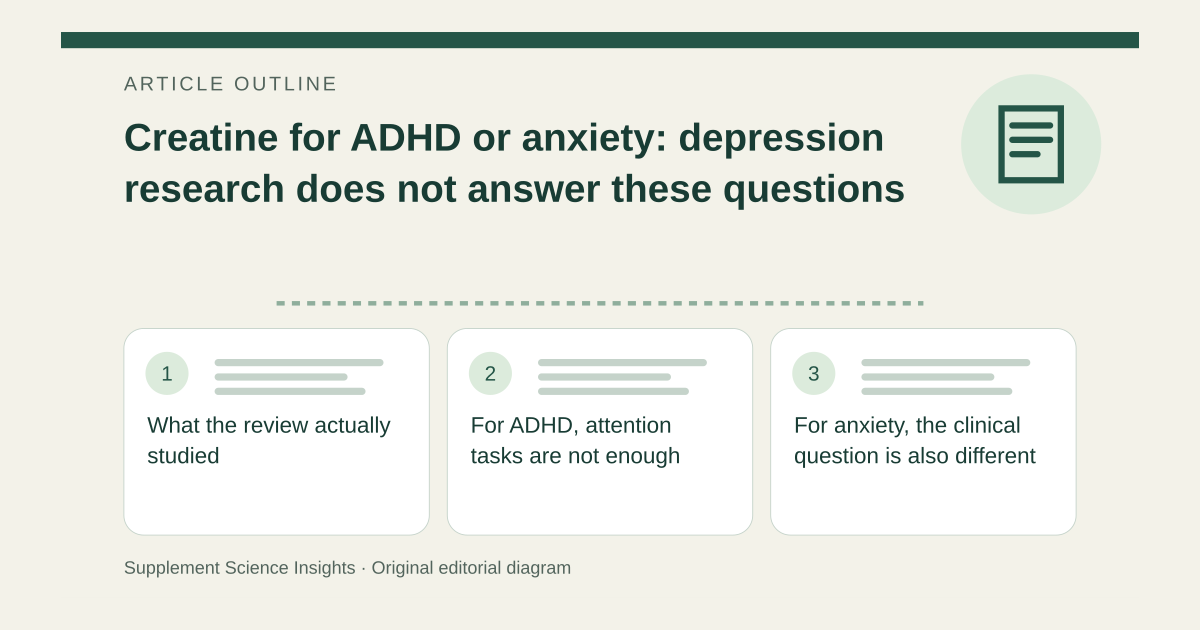
What the review actually studied
A 2026 systematic review searched through September 2025 and included five randomized trials, all in major or bipolar depression. Creatine was added to medication or psychotherapy, and findings were mixed. No other mental disorder was represented in its eligible trials. This describes that review’s evidence base, not a guarantee that no later study can exist. [1]
For ADHD, attention tasks are not enough
ADHD involves persistent inattention and/or hyperactivity-impulsivity across settings that interferes with daily life. An improvement on a memory or fatigue task in a different population would not establish treatment of ADHD symptoms or functioning. The inspected review supplies no ADHD-specific creatine treatment effect or dose. [2][1]
For anxiety, the clinical question is also different
Generalised anxiety disorder involves difficult-to-control worry with effects on daily life. A depression result does not demonstrate reduced anxiety in people diagnosed with GAD. NHS describes assessment, cognitive behavioural therapy and appropriate medicines as treatment options; the creatine review does not establish a substitute. [3][1]
Brain energy is a hypothesis, not a prescription
Creatine has a role in energy metabolism, but a plausible mechanism does not show which patients benefit or establish long-term psychiatric safety. The review’s short trials and small samples limit inference, and it reported a mania/hypomania signal in bipolar depression. No dedicated review funding was reported; several authors disclosed creatine-industry interests. [1]
Keep effective care in place
NIMH describes medication and psychosocial interventions, including parent and school approaches where appropriate, as standard ADHD treatments. Discuss supplements with the treating clinician rather than changing prescribed treatment. Review caffeine in blends, because it can aggravate anxiety or sleep problems. [2][4]
Match a claim to the diagnosed condition
Imagine a product cites a depression study to promise both better ADHD control and anxiety relief. Ask whether the research actually enrolled those patients and measured their symptoms and functioning. In this review, it did not. [1]
| Claim | Evidence needed |
|---|---|
| Helps ADHD | ADHD symptoms and functioning in relevant patients |
| Treats anxiety | Anxiety-disorder outcomes |
| Improves brain energy | Does not alone establish clinical benefit |
| Replaces therapy or medicine | Not supported by the inspected evidence |
Sources for this article
- The Effect of Creatine Monohydrate on Mental Disorders: A Systematic Review of Randomized Controlled Trials: Effet du monohydrate de créatine sur les troubles mentaux : examen systématique des essais contrôlés à répartition aléatoire - PMC
Source consulted: 2026-09-21. This is a reference resource, not a claim that we conducted the studies or tested a product. - Attention-Deficit/Hyperactivity Disorder (ADHD) - National Institute of Mental Health (NIMH)
Source consulted: 2026-09-21. This is a reference resource, not a claim that we conducted the studies or tested a product. - Generalised anxiety disorder (GAD) - NHS
Source consulted: 2026-09-21. This is a reference resource, not a claim that we conducted the studies or tested a product. - Spilling the Beans: How Much Caffeine is Too Much? | FDA
Source consulted: 2026-09-21. This is a reference resource, not a claim that we conducted the studies or tested a product.