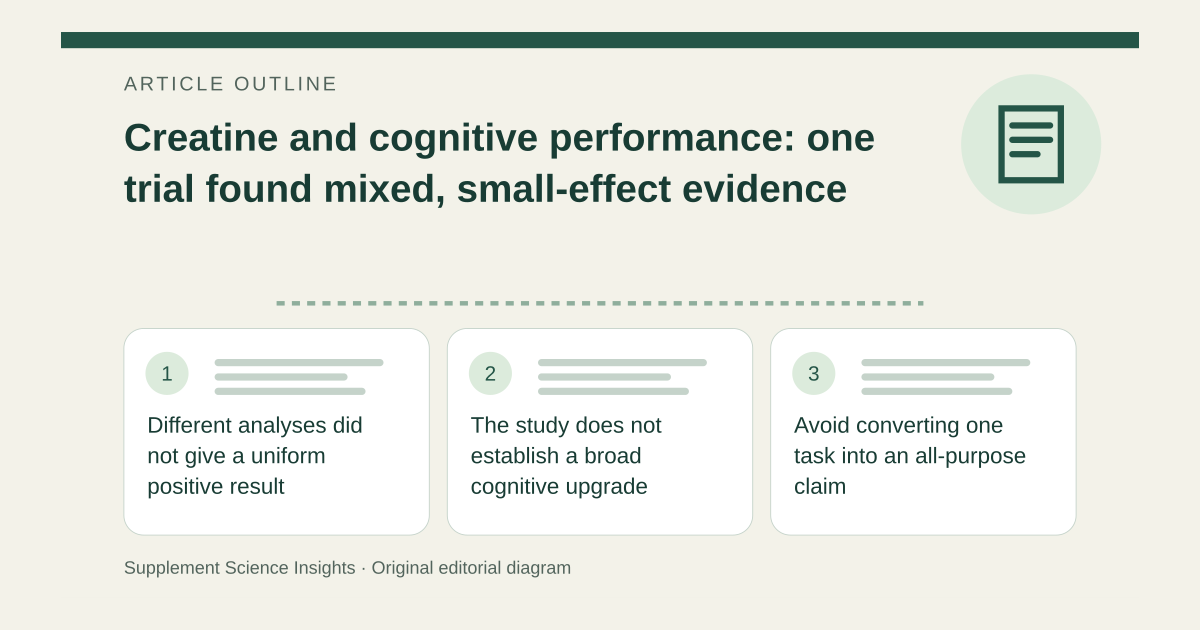
Different analyses did not give a uniform positive result
The double-blind trial tested 123 participants during creatine and placebo periods lasting six weeks each. About half were vegetarians and half omnivores. [1]
The backward-digit-span result did not reach the conventional 0.05 significance threshold, and the reasoning task showed no significant improvement. Bayesian analysis supported a small beneficial effect. Eight exploratory tests gave no indication of improvement. [1]
The study does not establish a broad cognitive upgrade
Vegetarians did not benefit more than omnivores. Reported side effects were more common during creatine supplementation, although the abstract does not fully characterize them. [1]
The authors declared no competing interests; funding was not established from the abstract. The mixed results leave uncertainty about a small task-specific effect. They do not demonstrate higher general intelligence, prevention of dementia or the same effect in every age group. [1]
Avoid converting one task into an all-purpose claim
Imagine a supplement might slightly improve one memory task while other tests remain unchanged. Calling that a general improvement in intelligence would extend the evidence beyond the measured result.
| Detail | Interpretation |
|---|---|
| Backward digit span | Uncertain small-effect signal |
| Reasoning and exploratory tasks | No significant or indicated improvement |
| Vegetarian subgroup | No greater benefit |
Are cognitive findings just a consequence of exercise?
Cognitive research is not simply a report of stronger muscles. A placebo-controlled crossover trial in 45 young adult vegetarians studied 5 g/day of creatine for six weeks and assessed backward digit span and a reasoning test. It reported improvements on those tasks. The result concerns a selected dietary population and specific tests; it is not evidence that everyone becomes more intelligent. [2][3]
The broader memory review distinguished ordinary testing from stress conditions such as sleep deprivation, hypoxia or exhaustive exercise. That makes the study setting important. These findings do not establish that habitual exercise can never influence response, or quantify an effect statistically independent of every activity, diet and sleep factor. [2][3]
Does a loading phase make brain benefits happen faster?
The familiar muscle-loading study measured muscle creatine concentration, not the onset of a memory benefit. Reaching a muscle-store target sooner cannot be used as a clock for improved attention or reasoning. [4][5]
A 2026 crossover study tested a single 0.2 g/kg dose during 21 hours of sleep deprivation in 29 healthy adults, with cognitive testing over several hours. Selected tasks deteriorated less than with placebo. It did not compare a standard loading phase with steady daily dosing in normally rested people. This acute experimental result therefore does not establish a routine brain-health dose, a need to load, or a reason to replace sleep with creatine. [4][5]
Sources for this article
- The effects of creatine supplementation on cognitive performance-a randomised controlled study - PubMed
Source consulted: 2026-09-19. This is a reference resource, not a claim that we conducted the studies or tested a product. - Rae et al. — Oral creatine monohydrate and brain performance: placebo-controlled crossover trial
Source consulted: 2026-10-28. This is a reference resource, not a claim that we conducted the studies or tested a product. - Prokopidis et al. — Creatine supplementation and memory in healthy individuals
Source consulted: 2026-10-28. This is a reference resource, not a claim that we conducted the studies or tested a product. - Hultman et al. — Muscle creatine loading in men
Source consulted: 2026-10-28. This is a reference resource, not a claim that we conducted the studies or tested a product. - Gordji-Nejad et al. — Single-dose creatine during sleep deprivation
Source consulted: 2026-10-28. This is a reference resource, not a claim that we conducted the studies or tested a product.