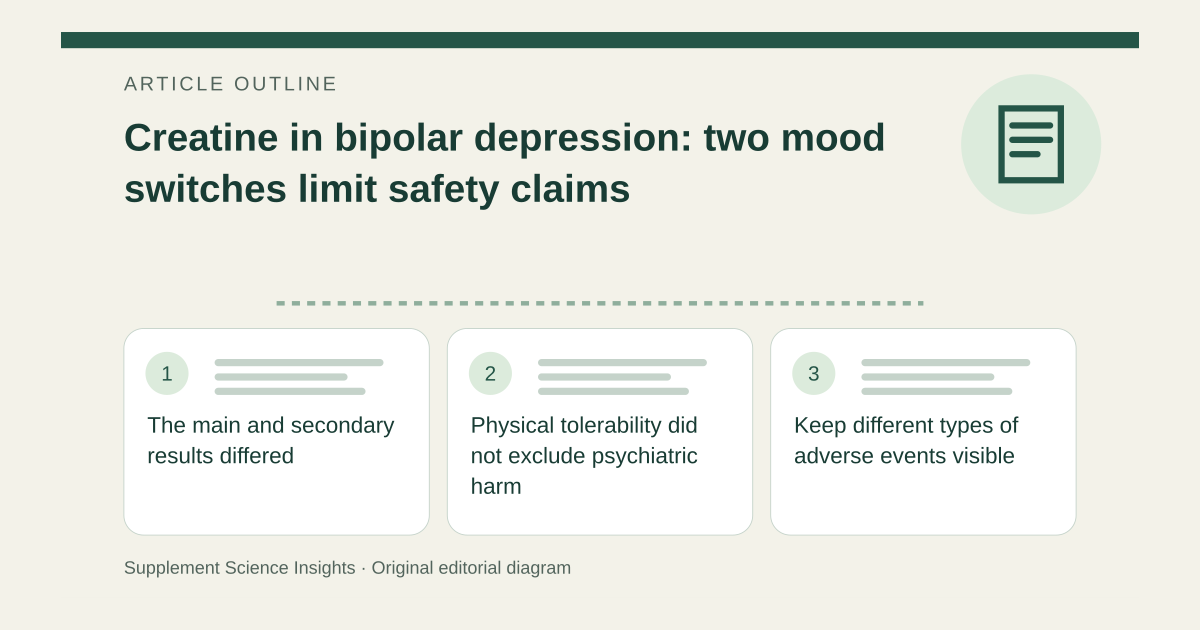
The main and secondary results differed
The double-blind trial enrolled 35 people with bipolar I or II depression already using regular medication. Participants received creatine monohydrate or placebo for six weeks. [1]
The primary comparison of depression-score change was not statistically significant. A secondary remission analysis favored creatine, but that finding does not erase the negative primary result. [1]
Physical tolerability did not exclude psychiatric harm
Two participants in the creatine group developed hypomania or mania early in the trial. This small study cannot give a reliable population-wide risk estimate, but the events directly contradict a blanket claim of established safety in bipolar disorder. [1]
Only 23 participants completed the trial. The listed authors reported no potential conflicts; funding was not established from the abstract. People with bipolar disorder should discuss this evidence with their treating clinician before adding creatine for mood symptoms. [1]
Keep different types of adverse events visible
Imagine a report finds no important physical side effects but records mood switches. Describing it simply as safe would omit a clinically important outcome.
| Detail | Interpretation |
|---|---|
| Primary score change | No significant group difference |
| Remission measure | Secondary favorable finding |
| Two mood switches | Material safety signal |
Sources for this article
- A randomized, double-blind, placebo-controlled, proof-of-concept trial of creatine monohydrate as adjunctive treatment for bipolar depression - PubMed
Source consulted: 2026-09-19. This is a reference resource, not a claim that we conducted the studies or tested a product.