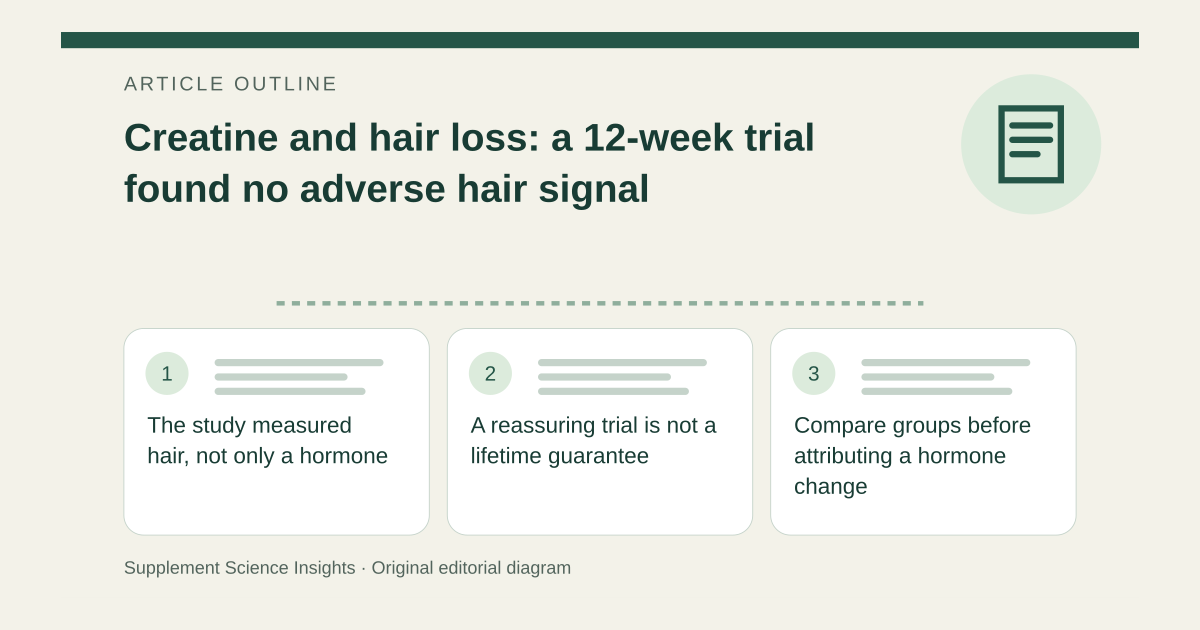
The study measured hair, not only a hormone
Researchers assigned 45 resistance-trained men aged 18–40 to creatine monohydrate or maltodextrin placebo for 12 weeks; 38 completed the study. Assessments included hair density, follicular units, cumulative thickness and circulating androgens. [1]
There were no significant group-by-time differences in the hormone or hair outcomes. Changes in total and free testosterone occurred over time in both groups and were not attributable to creatine supplementation. [1]
A reassuring trial is not a lifetime guarantee
The result argues against a hair-loss effect under these study conditions. It cannot exclude small effects, effects after years of use or different responses in other populations. [1]
Several authors disclosed supplement-industry advisory, research-support or consulting relationships. The abstract did not fully establish study funding. Persistent hair loss still needs its own assessment; a supplement trial cannot identify the cause for an individual. [1]
Compare groups before attributing a hormone change
Imagine testosterone rises in both the creatine and placebo groups. A rise in the creatine group alone does not prove that creatine caused it; the between-group comparison matters.
| Detail | Interpretation |
|---|---|
| Direct hair measurements | Stronger relevance than a hormone alone |
| 38 completers | Limited sample |
| 12 weeks | Not lifelong exposure |
Sources for this article
- Does creatine cause hair loss? A 12-week randomized controlled trial - PubMed
Source consulted: 2026-09-19. This is a reference resource, not a claim that we conducted the studies or tested a product.