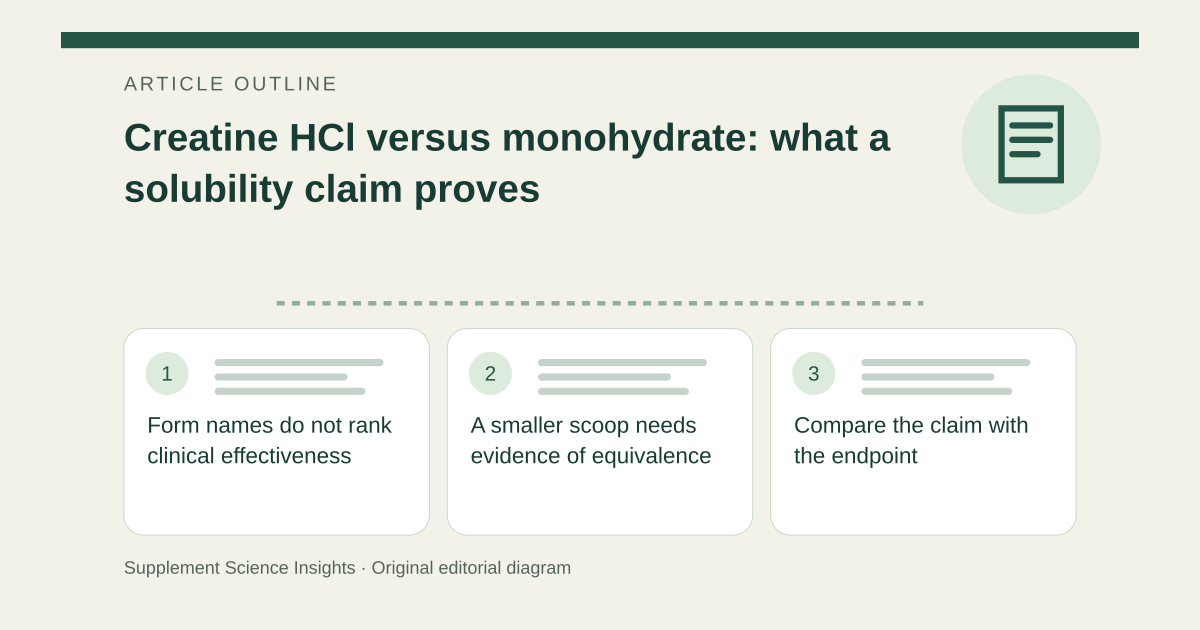
Form names do not rank clinical effectiveness
Creatine hydrochloride, often called creatine HCl, and creatine monohydrate are different forms used in supplements. ODS identifies monohydrate as the most extensively studied form and says alternative forms have not been proven superior for the stated performance and safety outcomes. [1][2]
The 2021 review likewise distinguishes solubility from delivery to muscle. A formulation can have different physical properties without demonstrating a larger training benefit. [1][2]
A smaller scoop needs evidence of equivalence
A claim that a form works at a much lower serving requires an appropriate comparison of actual creatine exposure and relevant outcomes. Faster dissolution by itself does not provide that comparison. [1][2]
Do not infer an HCl-to-monohydrate conversion ratio from marketing language. Nor does the total mass of a flavored blend establish its creatine amount. The ingredient amount and formulation must remain explicit. [1][2]
Compare the claim with the endpoint
Imagine one label emphasizes easy mixing while another refers to resistance-training studies. These statements address different endpoints, so they cannot be ranked by treating them as the same test.
A meaningful superiority claim would need a suitable head-to-head study, comparable exposure and an outcome that matters to the user. A glass that looks clearer is not that study.
| Observation | Interpretation |
|---|---|
| More soluble | A physical-property claim |
| Equivalent lower amount | Requires dose-comparison evidence |
| Better training outcome | Requires a relevant clinical comparison |
Research on a form does not verify every brand
The better-established monohydrate literature is not proof that all monohydrate products match study material or contain exactly their declared amount. No retail brand is evaluated here. [1][2]
The ODS summary dates to 2024 and the review to 2021; several review authors disclose creatine-industry ties. This scoped comparison does not claim an exhaustive search of every newer HCl trial. [1][2]
Sources for this article
- NIH ODS: Dietary Supplements for Exercise and Athletic Performance
Source consulted: 2026-09-17. This is a reference resource, not a claim that we conducted the studies or tested a product. - Antonio et al. (2021): Common questions and misconceptions about creatine supplementation
Source consulted: 2026-09-17. This is a reference resource, not a claim that we conducted the studies or tested a product.