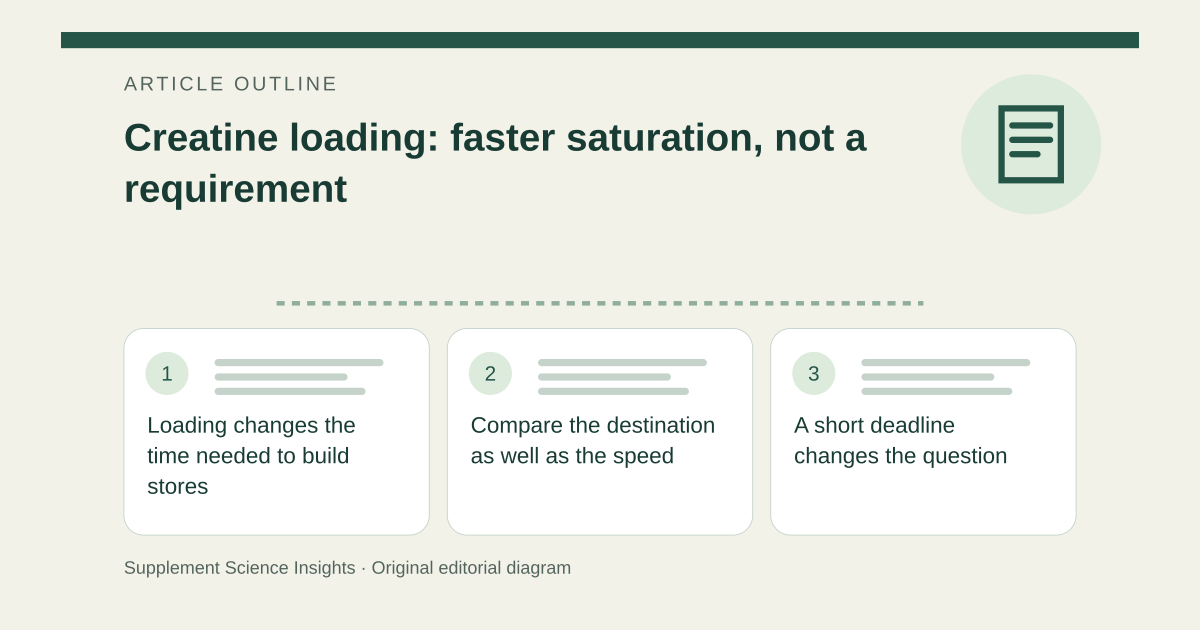
Loading changes the time needed to build stores
Creatine supplementation aims to increase the amount available in muscle. Loading describes a short period of higher intake followed by lower maintenance intake. It is a strategy for reaching higher stores sooner, not a separate ingredient or a prerequisite for all benefit. [1][2]
NIH ODS describes adult research protocols using 20 g/day in four portions for five to seven days, then 3–5 g/day. It also describes lower daily protocols without loading over three to four weeks. These are descriptions of research practice, not a personal prescription. [1][2]
Compare the destination as well as the speed
A 2021 review describes similar muscle accumulation after a lower daily regimen over about four weeks and a higher loading regimen over several days. The practical distinction is the pace of accumulation, rather than a rule that the slower approach cannot work. [2][1]
Higher intake can also bring early weight changes and gastrointestinal discomfort. An upcoming event does not make loading necessary or establish that an individual will tolerate it. [2][1]
A short deadline changes the question
Imagine two otherwise similar adults begin supplementation, but one expects a major training change next week and the other is following a longer program. Their timelines differ; neither can infer personal results from a schedule alone.
A loading-versus-maintenance comparison should therefore state when stores and performance were measured, instead of calling every shorter study a failure of the slower approach.
| Observation | Interpretation |
|---|---|
| Several days of higher intake | Faster approach to increased stores |
| Several weeks of lower daily intake | Studied non-loading approach |
| Personal suitability | Not decided by either timetable |
Keep population and source limits attached
The cited protocols concern adults and largely healthy exercise participants. They do not establish an appropriate plan for a child, pregnancy or kidney disease. [1][2]
The review dates to 2021 and reports several author relationships with the creatine industry. This page uses it alongside the ODS summary, without independently reappraising each trial. [1][2]
Sources for this article
- NIH ODS: Dietary Supplements for Exercise and Athletic Performance
Source consulted: 2026-09-17. This is a reference resource, not a claim that we conducted the studies or tested a product. - Antonio et al. (2021): Common questions and misconceptions about creatine supplementation
Source consulted: 2026-09-17. This is a reference resource, not a claim that we conducted the studies or tested a product.