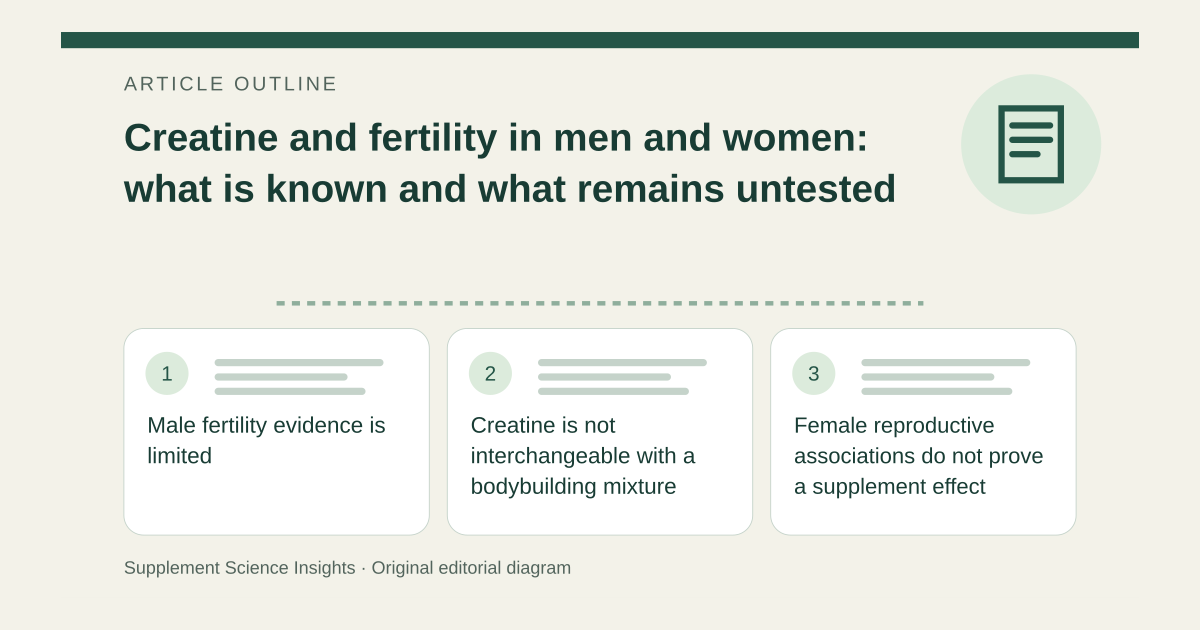
Male fertility evidence is limited
A 2025 narrative review reported that direct human supplementation studies of creatine monohydrate on male fertility indices were not available in its evidence base. It discussed sperm exposed to creatine-related compounds in laboratory media and observational supplement-use data. Neither is equivalent to showing that an oral powder improves conception or causes infertility. [1]
Creatine is not interchangeable with a bodybuilding mixture
The same review distinguishes creatine from multi-ingredient products that may contain other substances, including anabolic steroids. A fertility concern involving such a product should not automatically be assigned to pure creatine. Conversely, a creatine label does not establish that an entire blend is appropriate. [1][2]
Female reproductive associations do not prove a supplement effect
The women’s-health review describes associations involving dietary creatine and reproductive outcomes, along with research on cycle physiology. These findings do not establish that creatine supplementation causes or prevents female infertility. Food-intake associations are particularly vulnerable to differences in overall nutrition and health. [3]
Pregnancy is a separate safety question
Much of the reviewed work on fetal protection was preclinical, with human dosing and tolerability research still developing. Do not turn animal findings into a pregnancy recommendation. Tell the fertility or maternity team about supplements when planning conception or pregnancy. [3][4]
Use cause-specific fertility care
Fertility treatment depends on the underlying problem and may involve medicines, procedures or assisted conception. A supplement trial at home should not delay an appropriate assessment. Both creatine reviews disclose commercial relationships; the women’s review also had industry-supported publication costs. [4][1][3]
Ask which outcome a study measured
Imagine an advertisement cites faster sperm movement in laboratory media as proof that a daily scoop increases pregnancy rates. The route of exposure and outcome are different. That evidence cannot provide the advertised conclusion. [1]
| Evidence | What it cannot establish alone |
|---|---|
| Sperm in laboratory media | Effect of oral supplementation on conception |
| Dietary intake association | Cause or treatment of infertility |
| Animal pregnancy findings | Human pregnancy safety |
| Muscle performance benefit | Reproductive benefit |
Sources for this article
- Part II. Common questions and misconceptions about creatine supplementation: what does the scientific evidence really show? - PMC
Source consulted: 2026-09-21. This is a reference resource, not a claim that we conducted the studies or tested a product. - Dietary Supplements for Exercise and Athletic Performance - Health Professional Fact Sheet
Source consulted: 2026-09-21. This is a reference resource, not a claim that we conducted the studies or tested a product. - Creatine in women’s health: bridging the gap from menstruation through pregnancy to menopause - PMC
Source consulted: 2026-09-21. This is a reference resource, not a claim that we conducted the studies or tested a product. - Treatment for infertility - NHS
Source consulted: 2026-09-21. This is a reference resource, not a claim that we conducted the studies or tested a product.