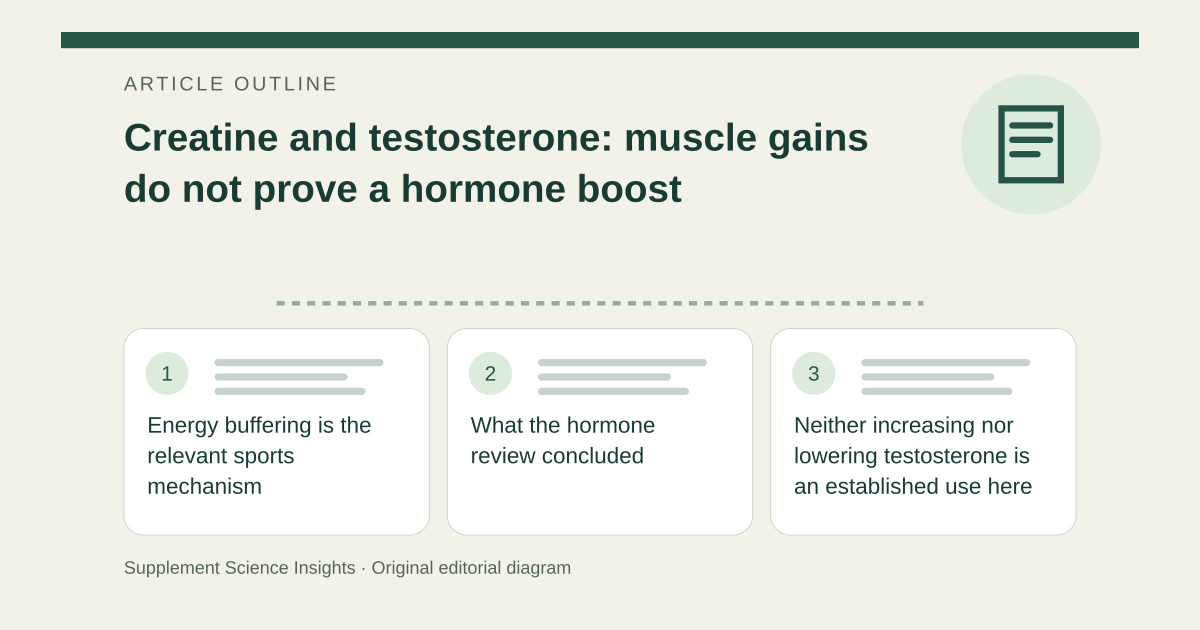
Energy buffering is the relevant sports mechanism
Creatine helps support phosphocreatine availability and rapid ATP regeneration during short, intense work. This can support repeated training efforts. It is different from administering an androgen, even when both appear in discussions of muscle size or strength. [1][2]
What the hormone review concluded
The 2021 review concluded that the body of evidence it assessed did not indicate increases in total testosterone, free testosterone or DHT. It discussed inconsistent individual findings rather than treating one result as settled proof. Several authors disclosed supplement-industry relationships; this is their review synthesis, not a newly conducted independent trial appraisal. [2]
Neither increasing nor lowering testosterone is an established use here
The cited guidance does not establish creatine as treatment for low testosterone or as a reliable way to suppress testosterone. A personal hormone concern needs evaluation on its own merits. A change in training, body composition or how someone feels cannot substitute for an appropriately interpreted clinical assessment. [1][2]
Growth-hormone claims need direct evidence too
More repetitions or muscle adaptation does not measure growth-hormone concentrations or prove an endocrine effect. The exercise guidance cited here does not establish a creatine regimen for raising growth hormone. Keep the performance outcome separate from an unmeasured hormone claim. [1]
A blend can introduce a different question
Imagine a product combines creatine with a hormone-support blend. Evidence for plain creatine does not assess every added ingredient or certify the product’s purity. Review the full formula rather than assigning all effects or risks to creatine. [3][1]
| Observation | Not automatically established |
|---|---|
| Improved repeated efforts | Higher testosterone |
| Greater muscle size with training | A growth-hormone effect |
| Creatine plus a blend | Safety of every additional ingredient |
Sources for this article
- Dietary Supplements for Exercise and Athletic Performance - Health Professional Fact Sheet
Source consulted: 2026-09-21. This is a reference resource, not a claim that we conducted the studies or tested a product. - Common questions and misconceptions about creatine supplementation: what does the scientific evidence really show? | Journal of the International Society of Sports Nutrition | Springer Nature Link
Source consulted: 2026-09-21. This is a reference resource, not a claim that we conducted the studies or tested a product. - Dietary Supplements: What You Need to Know
Source consulted: 2026-09-21. This is a reference resource, not a claim that we conducted the studies or tested a product.