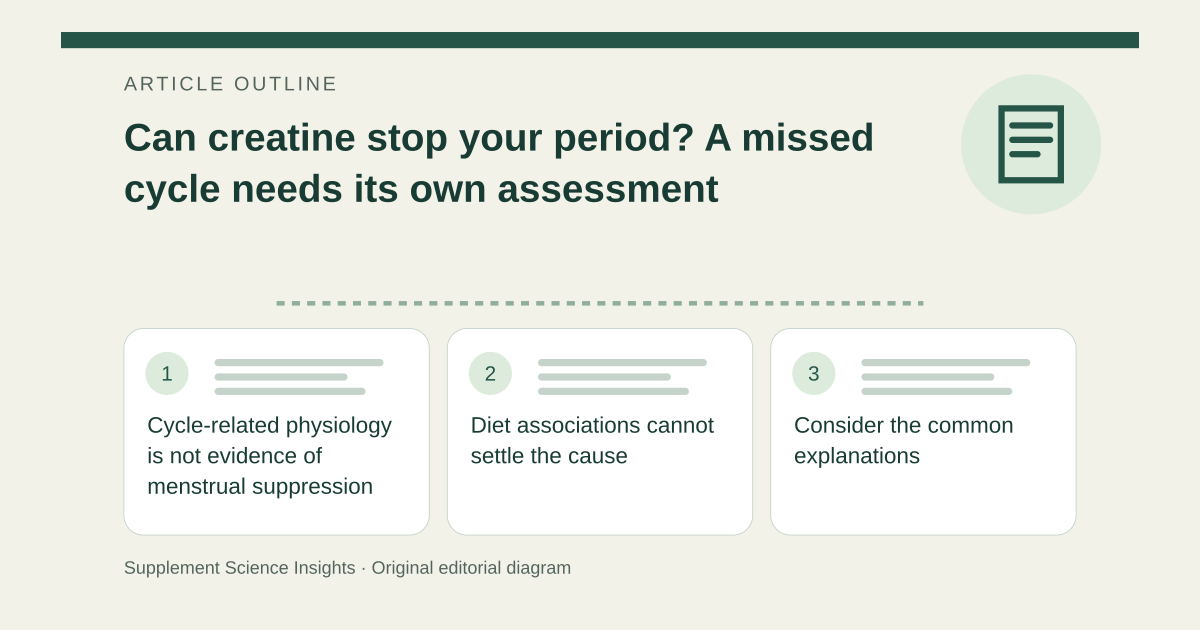
Cycle-related physiology is not evidence of menstrual suppression
A 2025 review discusses how reproductive hormones may influence creatine metabolism and how studies measure exercise or hydration across cycle phases. Those findings do not show that creatine stops ovulation or menstrual bleeding. [1]
Diet associations cannot settle the cause
The review also describes observational associations between dietary creatine intake and reproductive conditions. People with different diets can differ in many other ways. Such associations do not prove that taking a creatine powder either prevents or causes missed periods. The review’s publication was supported by Alzchem, and both authors disclosed advisory roles. [1]
Consider the common explanations
NHS lists pregnancy, stress, major weight changes, too much exercise, hormonal contraception, breastfeeding and perimenopause among causes of missed periods. A new gym supplement may coincide with a larger training or eating change. Do not assume the supplement explains a possible pregnancy or another condition. [2]
Know when to seek assessment
Get clinical advice if three periods are missed in a row, cycles become irregular, or a missed period comes with other symptoms such as weight changes or tiredness. Treatment depends on the cause. Discuss possible pregnancy and the complete supplement list rather than increasing a dose to try to regulate the cycle. [2]
Separate the changes in a real timeline
Imagine someone begins creatine, doubles training and loses weight before a period is missed. Record all three changes and the cycle dates. This supports assessment; it cannot by itself prove which change was responsible. [2][1]
| Detail | Why it matters |
|---|---|
| Cycle dates | Shows whether the pattern changed |
| Pregnancy possibility | Needs separate consideration |
| Training and weight changes | Recognized relevant context |
| Creatine and other products | Part of the full history |
Sources for this article
- Creatine in women’s health: bridging the gap from menstruation through pregnancy to menopause - PMC
Source consulted: 2026-09-21. This is a reference resource, not a claim that we conducted the studies or tested a product. - Missed or late periods - NHS
Source consulted: 2026-09-21. This is a reference resource, not a claim that we conducted the studies or tested a product.