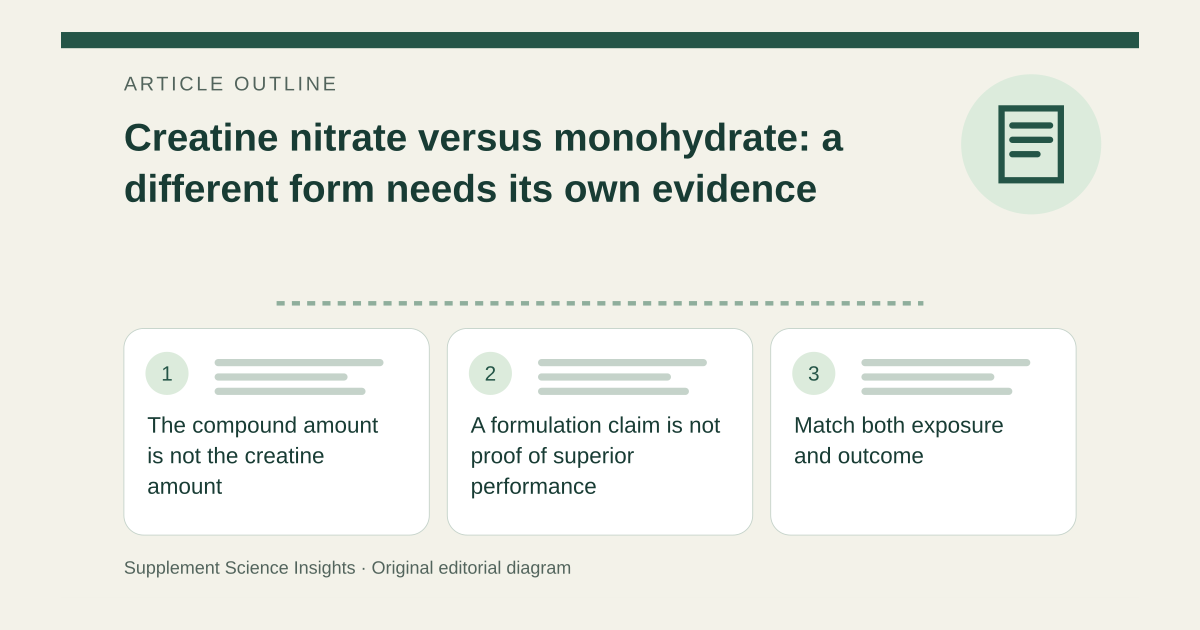
The compound amount is not the creatine amount
The cited scientific review discusses nitrate among alternative creatine forms and finds no established advantage for increasing muscle creatine stores over monohydrate. Equal weights of different compounds do not necessarily supply equal amounts of creatine. [1]
That matters when a label compares a gram amount of one form with a gram amount of another. The ingredient’s full chemical composition is part of the denominator. [1]
A formulation claim is not proof of superior performance
The review notes that apparent differences can relate to accompanying ingredients rather than greater creatine delivery. A claim about absorption, solubility or another component should not be substituted for a demonstrated exercise benefit. [1]
This is a review-based comparison, not an independent test of a specific retail product. It does not establish that every nitrate formulation is ineffective or that a blend matches the products evaluated in the literature. [1]
Match both exposure and outcome
Imagine two products each list 3 g of a named creatine compound. Before calling them equivalent or ranking them, determine the creatine amount and whether comparable performance outcomes were actually tested.
| Detail | Interpretation |
|---|---|
| Compound weight | Not always creatine weight |
| Muscle storage | A specific endpoint |
| Superior performance | Requires direct evidence |
Sources for this article
- Common questions and misconceptions about creatine supplementation: what does the scientific evidence really show? | Journal of the International Society of Sports Nutrition | Springer Nature Link
Source consulted: 2026-09-17. This is a reference resource, not a claim that we conducted the studies or tested a product.