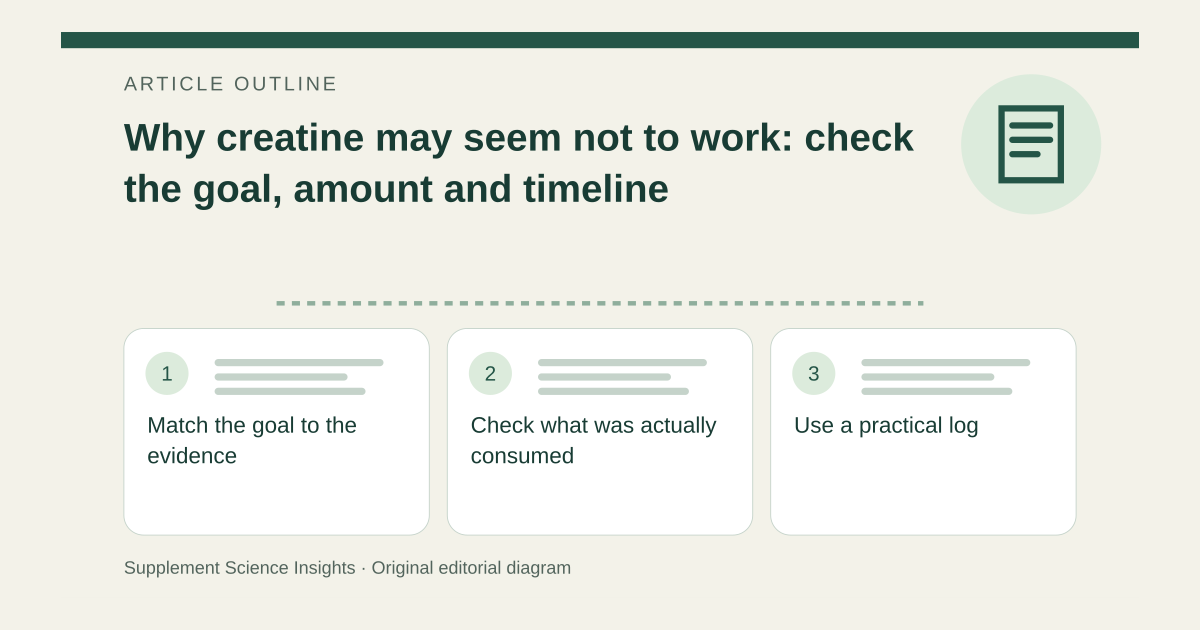
Match the goal to the evidence
Creatine’s sports evidence is strongest for repeated high-intensity effort and training adaptation. Someone expecting immediate alertness or a large improvement in steady endurance exercise may be judging the wrong outcome. Individual responses also vary with factors such as diet and muscle characteristics. [1]
Check what was actually consumed
Read the chemical form, declared amount and serving size. A blend may contain less creatine than expected, and skipped servings or leaving sediment behind changes exposure. More expensive alternative forms have not been shown in the ODS summary to outperform monohydrate consistently. Do not respond to uncertainty by repeatedly escalating doses. [1]
Use a practical log
Imagine someone has taken a small, inconsistent amount for a few days and sees no visible change. That does not establish failure. Record product use and a relevant repeated-effort measure across an appropriate training period, while keeping diet and training reasonably consistent. If no meaningful benefit appears or adverse effects occur, reassess the purpose rather than buying an ever larger stack. [1]
| Hypothetical concern | First check |
|---|---|
| No stimulant feeling | That is not the intended creatine effect |
| No visible change in days | Timeline and outcome may be unsuitable |
| No performance benefit | Goal, intake, training and individual response |
Sources for this article
- Dietary Supplements for Exercise and Athletic Performance - Health Professional Fact Sheet
Source consulted: 2026-09-20. This is a reference resource, not a claim that we conducted the studies or tested a product.