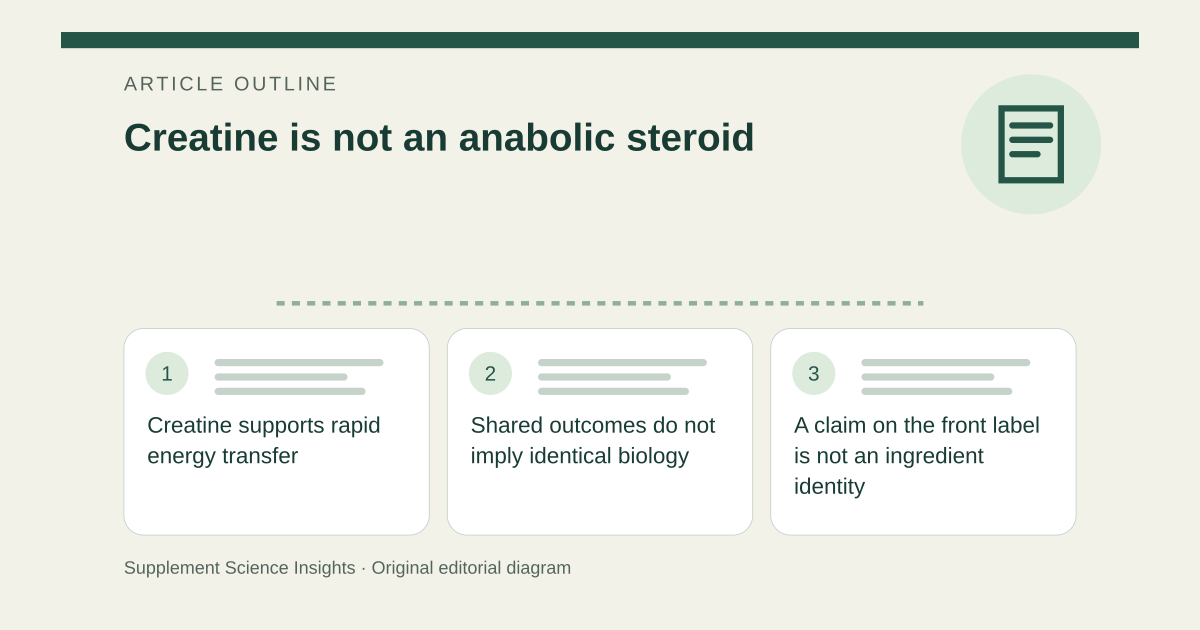
Creatine supports rapid energy transfer
Creatine is converted to phosphocreatine, which helps regenerate ATP during short, intense muscle work. Increasing muscle creatine availability can support repeated efforts and the amount of training performed. [1][2]
Anabolic steroids act through androgen-related pathways. The 2021 review explains that creatine has a different chemical structure and does not work by being a synthetic version of testosterone. [1][2]
Shared outcomes do not imply identical biology
Both substances can appear in discussions of strength or muscle size. That overlap in a claimed outcome cannot identify a substance or show that it acts on the same receptor. [1][2]
Creatine-related gains during a training program are not proof of a steroid-like hormonal effect. The relevant comparisons retain the actual ingredient, training program and measured outcome. [1][2]
A claim on the front label is not an ingredient identity
Imagine two products each advertise muscle support. One phrase cannot establish that they contain the same compound, use the same pathway or carry the same risks.
Reading the ingredients is a necessary first step. Even then, a label alone is not independent laboratory verification of product contents.
| Observation | Interpretation |
|---|---|
| Same advertised outcome | Not the same mechanism |
| Creatine as an ingredient | Not an anabolic steroid |
| A retail container | Its full contents remain a separate question |
The ingredient distinction is not a product guarantee
Knowing that creatine itself is not a steroid does not certify the purity or composition of every product marketed with that word. This page does not verify any retail product or make a competition-eligibility determination. [1][2]
The mechanism explanation uses ODS and the 2021 review; several review authors disclose industry relationships. No legal classification or current sports-rule advice is inferred from the older review. [1][2]
Sources for this article
- NIH ODS: Dietary Supplements for Exercise and Athletic Performance
Source consulted: 2026-09-17. This is a reference resource, not a claim that we conducted the studies or tested a product. - Antonio et al. (2021): Common questions and misconceptions about creatine supplementation
Source consulted: 2026-09-17. This is a reference resource, not a claim that we conducted the studies or tested a product.