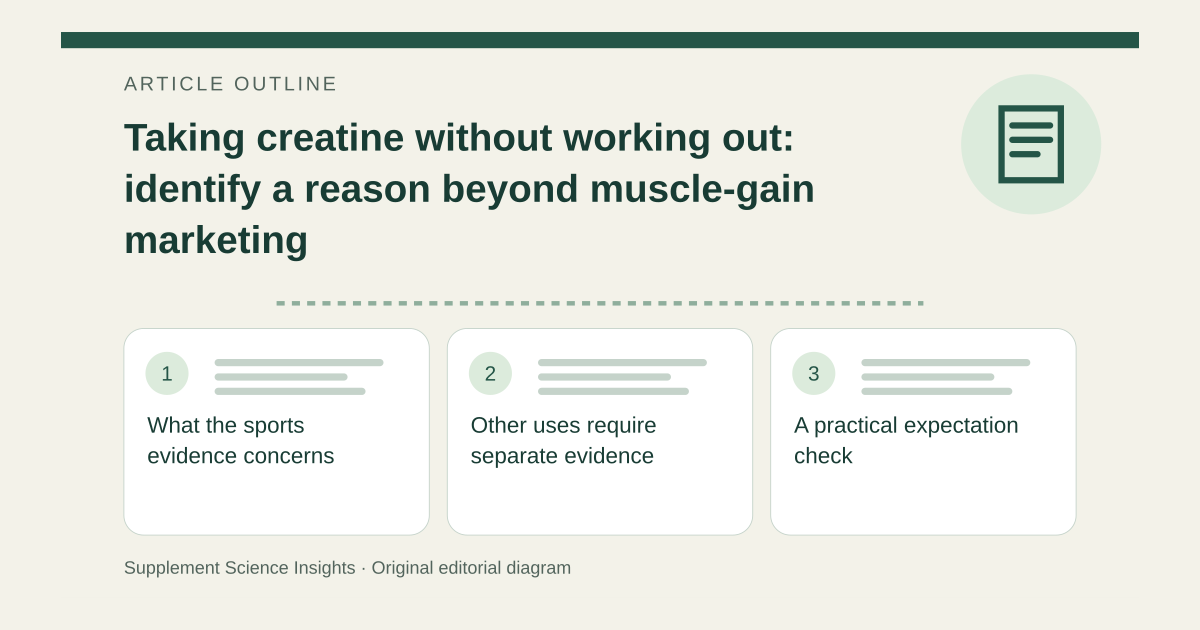
What the sports evidence concerns
NIH ODS describes benefits for certain short, intense efforts and adaptations to structured training. Those findings should not be rewritten as a promise that taking a powder while sedentary builds the same strength or muscle. The body already makes creatine and obtains some from animal foods. [1]
Other uses require separate evidence
A clinical or cognitive research question is different from a general sports claim. The relevant population, formulation and outcome need their own assessment, and this page does not recommend creatine as a treatment for a medical condition. Having no workout planned does not establish either a need for supplementation or a contraindication by itself. [1]
A practical expectation check
Imagine someone starts creatine expecting a visibly muscular body without resistance training. A change on the scale may include water and is not proof of newly built contractile muscle. Define the actual goal and consider the evidence for it before continuing, rather than interpreting every weight change as success. [1]
| Hypothetical expectation | Evidence boundary |
|---|---|
| Better repeated intense efforts | Relevant sports-use context |
| Muscle gain without training | Not established by training trials |
| Scale weight rises | Does not identify muscle gain alone |
Sources for this article
- Dietary Supplements for Exercise and Athletic Performance - Health Professional Fact Sheet
Source consulted: 2026-09-20. This is a reference resource, not a claim that we conducted the studies or tested a product.