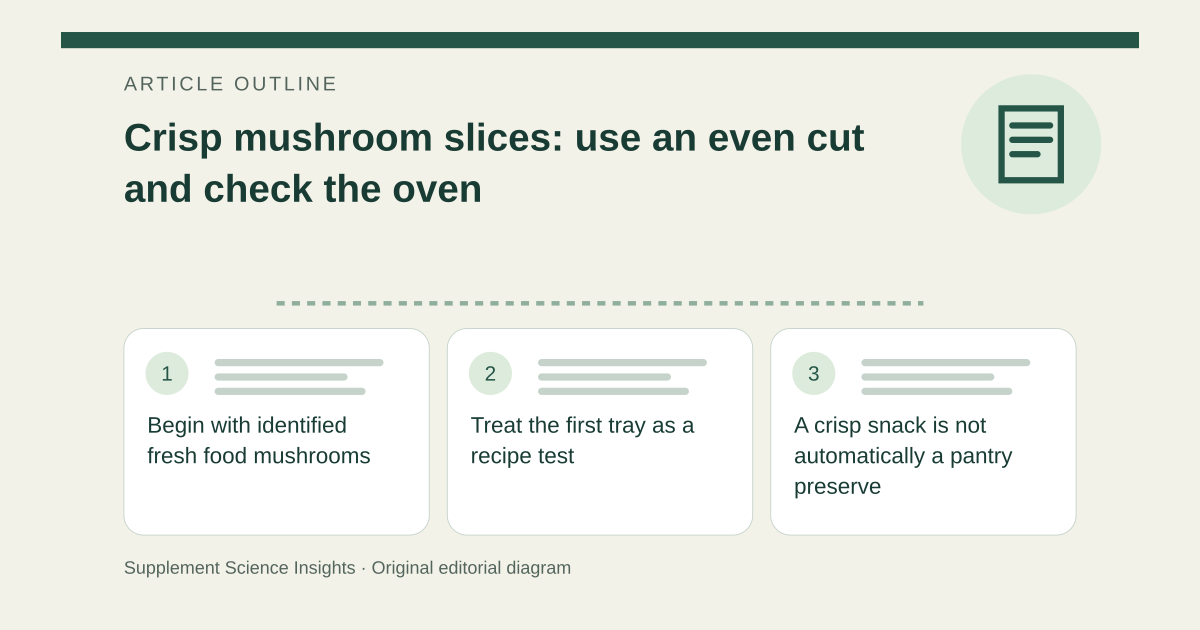
Begin with identified fresh food mushrooms
Use sound mushrooms from a reliable food source, clean them near cooking and cut reasonably even slices. Uneven thickness creates a mixture of fast-browning edges and wetter centers. USU describes roasting mushrooms at 400°F; for thin slices, monitor earlier than a whole-mushroom recipe because size changes the cooking time. [1]
Treat the first tray as a recipe test
As an original kitchen approach, spread the slices in one layer with a light coating of oil and seasoning. Check frequently and remove pieces as they become crisp enough for the intended dish, before they burn. Exact time depends on the slices and oven. Avoid promising that a fixed minute count works for every variety or batch. [1]
A crisp snack is not automatically a pantry preserve
Imagine the slices feel crisp when hot but soften as they cool. That texture change is not a measurement of water activity or proof of shelf stability. Treat homemade roasted mushrooms as cooked food and follow USDA leftover handling unless using a separate validated preservation process. [2][3]
| Example | Interpretation |
|---|---|
| Even thin slices | More consistent cooking |
| Crisp surface | Not a shelf-stability test |
| Leftovers | Use safe cooked-food storage |
Sources for this article
- Fruit and Vegetable Guide Series: Mushrooms | USU
Source consulted: 2026-09-20. This is a reference resource, not a claim that we conducted the studies or tested a product. - Leftovers and Food Safety | Food Safety and Inspection Service
Source consulted: 2026-09-20. This is a reference resource, not a claim that we conducted the studies or tested a product. - Storage & Preservation - Cornell Small Farms
Source consulted: 2026-09-20. This is a reference resource, not a claim that we conducted the studies or tested a product.