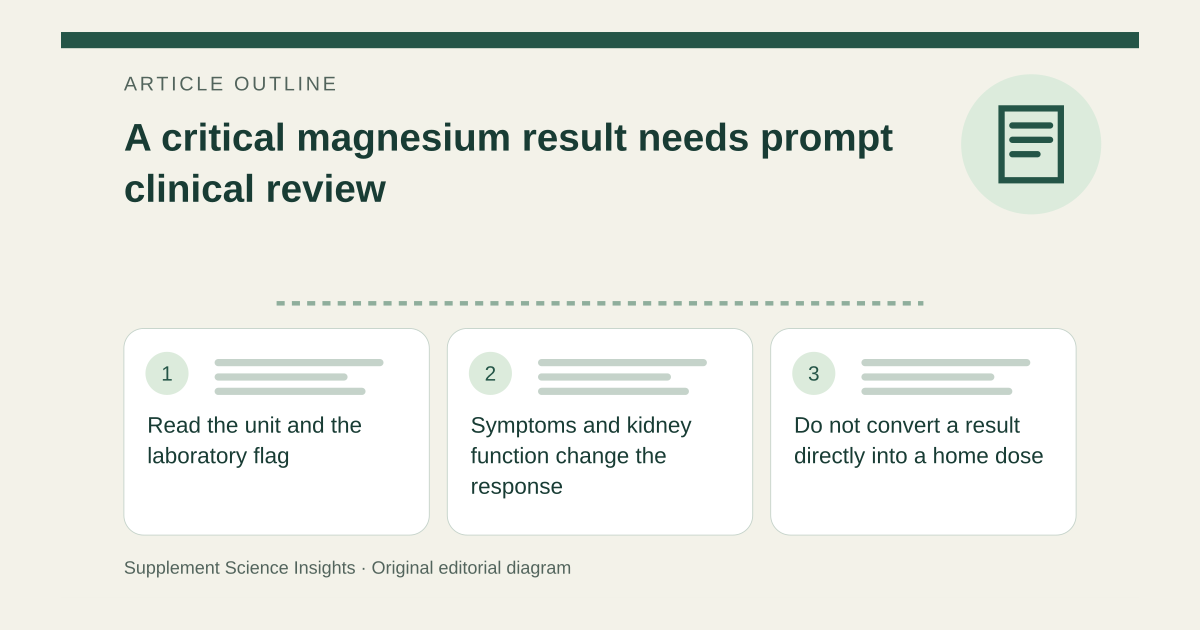
Read the unit and the laboratory flag
Mayo’s serum-magnesium catalog gives an adult reference interval of 1.7–2.3 mg/dL. It notes that deficiency symptoms typically appear around 1.0 mg/dL or below and that 9.0 mg/dL or above may be life-threatening. These are that laboratory’s statements, not boundaries below which every person is safe or universal critical-notification rules. [1]
Symptoms and kidney function change the response
Severe magnesium abnormalities can affect heart rhythm, muscles and the nervous system. Kidney impairment and magnesium-containing supplements or medicines matter particularly for high levels. A critical alert warrants prompt contact with the treating team; severe symptoms such as collapse, seizures or breathing difficulty require emergency care. [2][1]
Do not convert a result directly into a home dose
Imagine a report expressed in mmol/L while an online example uses mg/dL. The numbers cannot be compared without accounting for units. Take the full report to the clinician rather than adding magnesium, stopping other treatment or waiting until a quoted internet threshold is reached. [1][3]
| Situation | Next interpretation step |
|---|---|
| Critical flag | Contact the treating team promptly |
| Different units | Do not compare raw numbers |
| Severe symptoms | Seek emergency assessment |
Sources for this article
- MGS - Overview: Magnesium, Serum
Source consulted: 2026-09-20. This is a reference resource, not a claim that we conducted the studies or tested a product. - Magnesium - Health Professional Fact Sheet
Source consulted: 2026-09-20. This is a reference resource, not a claim that we conducted the studies or tested a product. - How to Prepare for a Lab Test: MedlinePlus Medical Test
Source consulted: 2026-09-20. This is a reference resource, not a claim that we conducted the studies or tested a product.