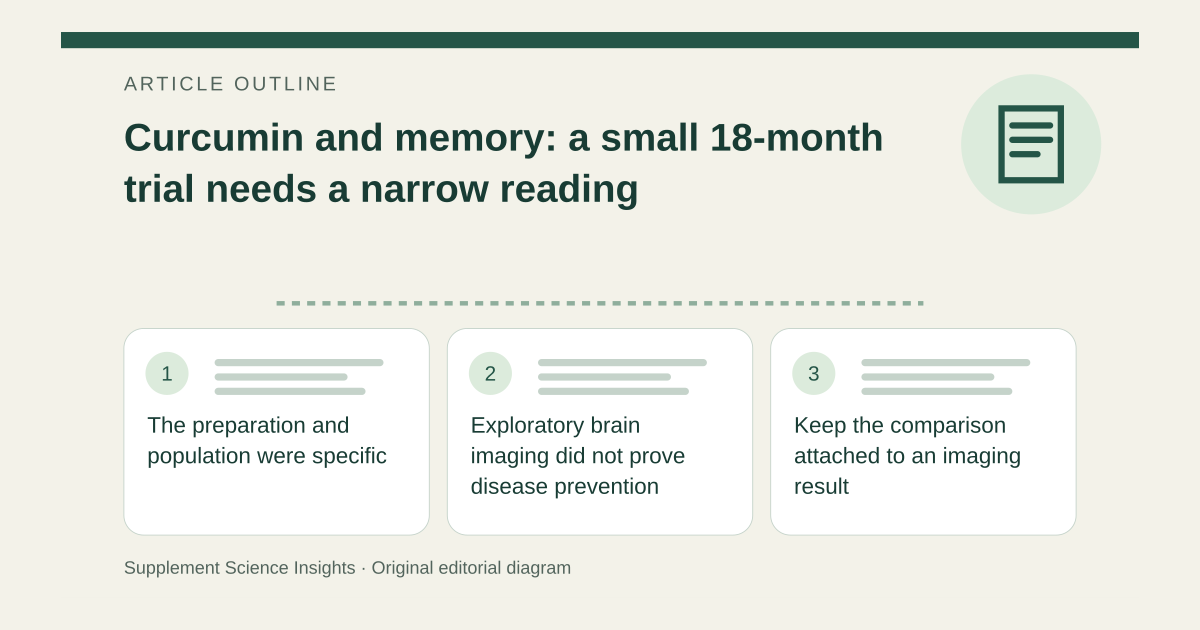
The preparation and population were specific
Forty adults aged 51–84 without dementia were randomized to a bioavailable curcumin formulation or placebo for 18 months. Verbal and visual memory were primary outcomes; attention was secondary. [1]
The report described favorable cognitive findings, including a between-group result at the conventional significance boundary for one verbal-memory measure. The small sample makes the size and reproducibility of the effect uncertain. [1]
Exploratory brain imaging did not prove disease prevention
Thirty participants had PET measurements. Findings differed by brain region, and a within-group amygdala change did not correspond to a conventionally significant between-group difference. [1]
These measurements do not establish prevention of Alzheimer’s disease or treatment of dementia. Funding and conflicts were not fully assessed from the abstract. The result concerns the tested formulation, not an equivalent effect from adding turmeric to food or using any product advertised for brain health. [1]
Keep the comparison attached to an imaging result
Imagine a scan signal changes within one group. The relevant treatment comparison still asks whether that change differs reliably from the control group.
| Detail | Interpretation |
|---|---|
| 40 participants | Small clinical trial |
| Named formulation | Preparation-specific evidence |
| Dementia prevention | Not demonstrated |
Sources for this article
- Memory and Brain Amyloid and Tau Effects of a Bioavailable Form of Curcumin in Non-Demented Adults: A Double-Blind, Placebo-Controlled 18-Month Trial - PubMed
Source consulted: 2026-09-19. This is a reference resource, not a claim that we conducted the studies or tested a product.