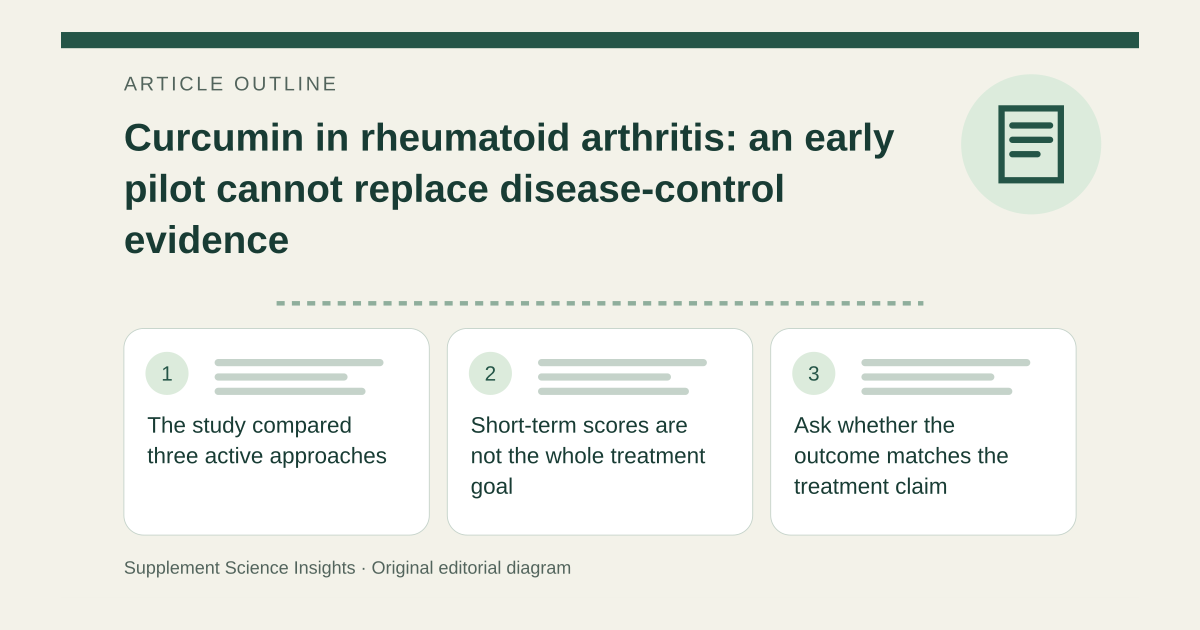
The study compared three active approaches
People with active rheumatoid arthritis were randomized to curcumin, diclofenac or their combination. Disease-activity scores improved in all three groups, with the curcumin group showing the largest reported percentage improvements. [1]
The trial was described as a pilot and did not include a placebo group. Its authors called for larger studies to validate the findings. [1]
Short-term scores are not the whole treatment goal
The abstract does not establish long-term structural joint outcomes or equivalence to disease-modifying rheumatoid arthritis treatment. It also does not fully specify blinding, intervention duration, funding or conflicts. [1]
No curcumin-related adverse events were reported, but a small trial has limited power to detect uncommon harms. These findings can motivate research; they do not justify stopping rheumatology treatment or assuming that all turmeric preparations have the same effect as the studied curcumin product. [1]
Ask whether the outcome matches the treatment claim
Imagine joint tenderness improves during a short study. That alone does not show that long-term joint damage is prevented or that a prescribed disease-modifying medicine is unnecessary.
| Detail | Interpretation |
|---|---|
| 45 participants | Pilot scale |
| DAS28 and ACR measures | Reported symptom/activity findings |
| Joint-damage prevention | Not established |
Sources for this article
- A randomized, pilot study to assess the efficacy and safety of curcumin in patients with active rheumatoid arthritis - PubMed
Source consulted: 2026-09-19. This is a reference resource, not a claim that we conducted the studies or tested a product.