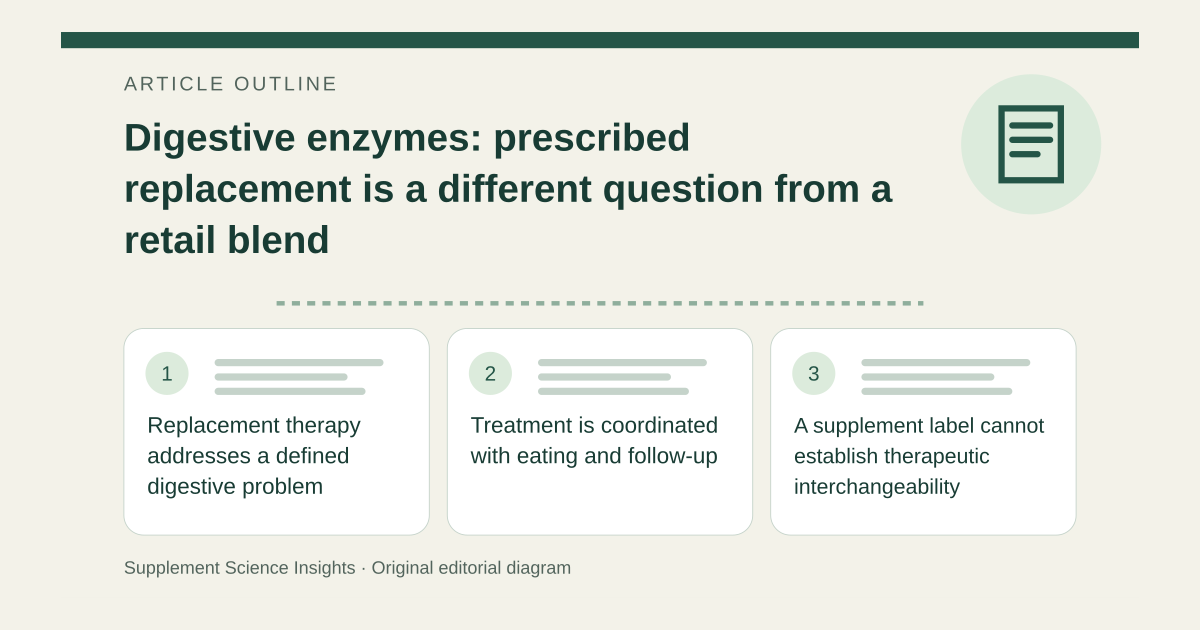
Replacement therapy addresses a defined digestive problem
NIDDK describes pancreatic enzyme replacement therapy, or PERT, as treatment for exocrine pancreatic insufficiency. The aim is to improve digestion, symptoms and the ability to obtain nutrients from food. The diagnosis supplies a specific reason for replacing enzyme activity. [1][2]
Bloating or discomfort alone does not establish that diagnosis. A product advertised for digestion cannot identify the cause of symptoms or demonstrate that pancreatic replacement is needed. [1][2]
Treatment is coordinated with eating and follow-up
NIDDK advises taking prescribed PERT during meals or snacks according to the treating clinician’s instructions. This links enzyme delivery to the food being digested, rather than treating it as an unrelated daily wellness pill. [1][2]
Care can also include assessment of malnutrition, low fat-soluble vitamin levels and low bone mass. The relevant outcomes extend beyond whether someone notices a short-term change in gas or fullness. [1][2]
A supplement label cannot establish therapeutic interchangeability
A retail blend listing several enzymes is not thereby the same preparation as prescribed PERT. The type of enzymes, delivered activity, formulation and clinical use all need to match before equivalence could be claimed. A longer ingredient list is not evidence of a better treatment. [1][2]
Do not replace prescribed enzyme therapy with an over-the-counter blend based on marketing language. Discuss tolerance, persistent symptoms and the exact regimen with the clinician managing the underlying condition. [1][2]
Count is not function
Imagine one label names ten enzymes and another prescription treatment has a clearly defined regimen. The ingredient count does not tell us which delivers the needed activity under the relevant digestive conditions. The clinical purpose is more informative than the number of names.
| Question | Relevant distinction |
|---|---|
| EPI diagnosis | Defines a replacement need |
| PERT with meals or snacks | Prescribed clinical use |
| Retail blend | Equivalence not established by label alone |
Sources for this article
- NIDDK: Treatment for Exocrine Pancreatic Insufficiency
Source consulted: 2026-09-17. This is a reference resource, not a claim that we conducted the studies or tested a product. - NIH ODS: Dietary Supplements — What You Need to Know
Source consulted: 2026-09-17. This is a reference resource, not a claim that we conducted the studies or tested a product.