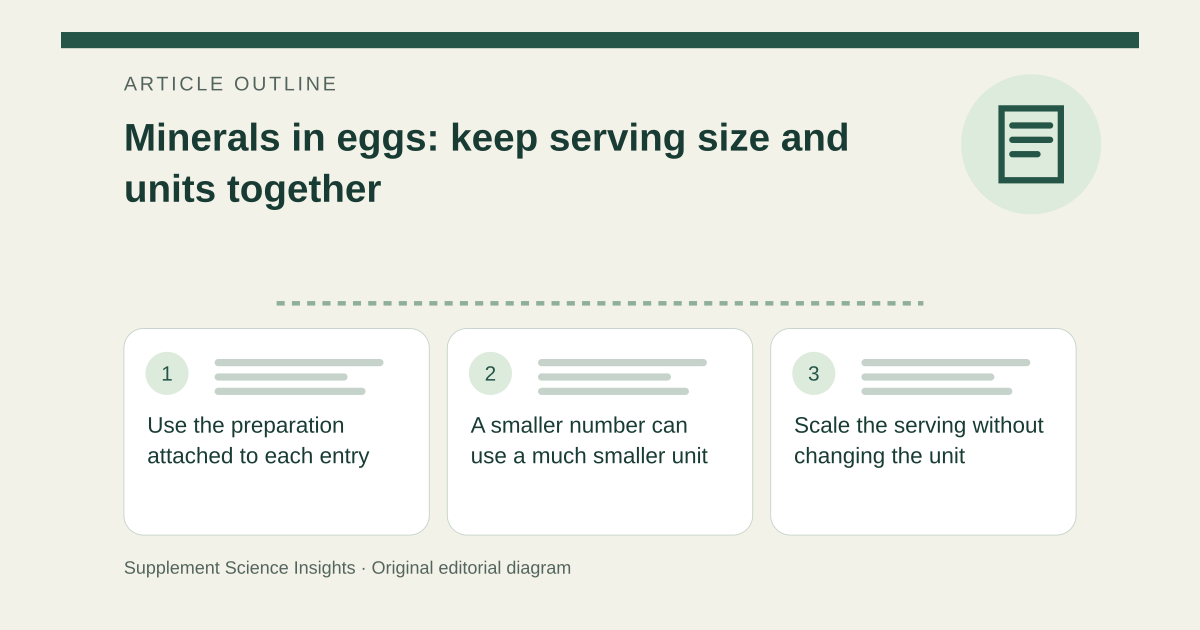
Use the preparation attached to each entry
USDA SR Legacy 2018 gives a large 50 g raw whole egg about 6 mg magnesium and 69 mg potassium. Its separate hard-boiled whole-egg entry gives about 5 mg magnesium and 63 mg potassium per 50 g egg. These come from per-100-g values of 12/138 mg and 10/126 mg, respectively, scaled by one half. They are historical reference entries, not a paired experiment measuring nutrient loss in the same egg or a recommendation to eat eggs raw. [1][2][3][4]
NIH ODS lists 15 mcg selenium and 86 mg phosphorus for a large hard-boiled egg. Its potassium table lists 69 mg for one large egg. These are food-reference values, not measurements of every individual egg. [1][2][3][4]
Egg size, preparation and added ingredients affect the portion being compared. A scrambled dish containing milk or other foods is not identical to the single-egg reference. [1][2][3][4]
A smaller number can use a much smaller unit
One milligram equals 1,000 micrograms. Comparing 15 mcg selenium with 86 mg phosphorus therefore requires keeping the units visible rather than ranking the bare numbers. [1][2][3]
These minerals also have different nutritional roles and intake references. Their amounts should not be added into a single meaningful mineral-strength score. [1][2][3]
Scale the serving without changing the unit
Imagine two matching large hard-boiled eggs. The reference selenium contribution doubles from 15 to 30 mcg, not 30 mg.
| Detail | Interpretation |
|---|---|
| Selenium | 15 mcg per listed egg |
| Phosphorus | 86 mg per listed egg |
| Potassium | 69 mg per listed egg |
Sources for this article
- Selenium - Health Professional Fact Sheet
Source consulted: 2026-09-18. This is a reference resource, not a claim that we conducted the studies or tested a product. - Phosphorus - Health Professional Fact Sheet
Source consulted: 2026-09-18. This is a reference resource, not a claim that we conducted the studies or tested a product. - Potassium - Health Professional Fact Sheet
Source consulted: 2026-09-18. This is a reference resource, not a claim that we conducted the studies or tested a product. - USDA FoodData Central: SR Legacy 2018 food composition dataset
Source consulted: 2026-09-20. This is a reference resource, not a claim that we conducted the studies or tested a product.