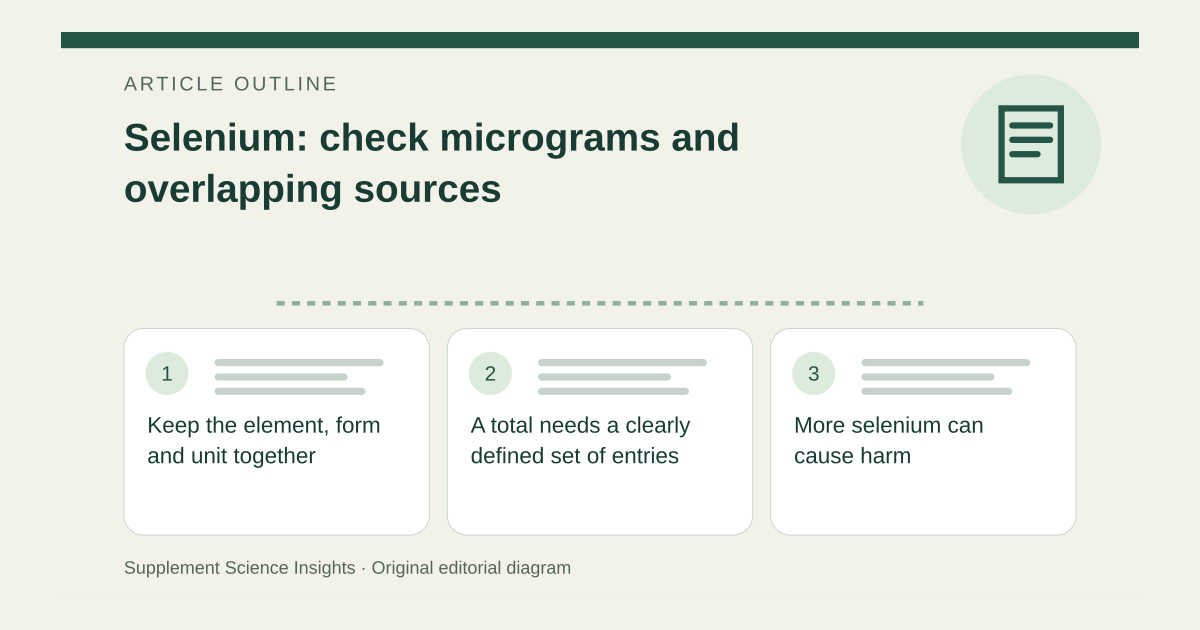
Keep the element, form and unit together
Selenium is an essential mineral. Common supplemental forms include selenomethionine, selenium-enriched yeast, sodium selenite and sodium selenate. NIH ODS describes its role in proteins involved in functions including thyroid hormone metabolism. [1]
That background is not a reason to prescribe selenium for a thyroid condition. For a label record, copy the selenium entry, unit, named form and serving definition. Keep any advertised benefit in a separate field so it is not mistaken for verified composition. [1]
A total needs a clearly defined set of entries
Imagine one fictional multivitamin entry with 50 micrograms selenium and another supplement entry with 20 micrograms, both recorded for the same period. These two entries sum to 70 micrograms. The result is 70 micrograms, not 70 milligrams.
This is a bookkeeping example, not an instruction to combine products or a recommended intake. It excludes any unrecorded food and supplements. If an amount or serving definition is missing, the worksheet cannot supply a complete total.
| Entry | Selenium for the recorded period |
|---|---|
| Multivitamin entry | 50 micrograms |
| Other supplement entry | 20 micrograms |
| Sum of these entries | 70 micrograms |
| Unrecorded food or products | Excluded; not assumed to be zero |
More selenium can cause harm
Chronically excessive selenium intake can cause selenosis, including hair loss and brittle or lost nails; gastrointestinal and nervous-system effects can also occur. ODS notes that high intakes of organic and inorganic forms can have similar harmful effects. [1]
A label emphasizing an organic form therefore does not remove the need to assess the amount and the rest of the intake record. Discuss possible excess or symptoms with a clinician instead of using hair or nail changes to diagnose a deficiency yourself. [1]
Do not use a food name as a precise dose
ODS describes Brazil nuts as a concentrated selenium source and notes variation in selenium in foods. A count of nuts is not a standardized replacement for a measured supplement entry. [1]
Keep food estimates separate from exact label declarations and record where an estimate came from. Do not add a precise-looking food number borrowed from a different portion and present the result as a laboratory measurement of intake. [1]
Ask what a thyroid claim actually measured
When assessing a claim, distinguish a change in a blood marker from an improvement in symptoms or another patient-relevant outcome. Record whether participants had diagnosed disease, low baseline intake or another selected characteristic.
An ingredient’s biological role does not answer whether supplementation helps someone already obtaining enough. This article does not rank forms for thyroid health or provide a treatment protocol. Those questions need a specific clinical review.
End with an accurate, limited record
The fictional worksheet supports one narrow statement: two documented entries total 70 micrograms for their shared recording period. It establishes neither absorbed selenium nor the amount appropriate for an individual.
The government synthesis supports the background and safety context cited here. No retail batch, product purity claim or clinical efficacy estimate is independently verified. The article remains subject to scientific and editorial review.
Sources for this article
- NIH ODS — Selenium: Health Professional Fact Sheet
Source consulted: 2026-09-17. This is a reference resource, not a claim that we conducted the studies or tested a product.