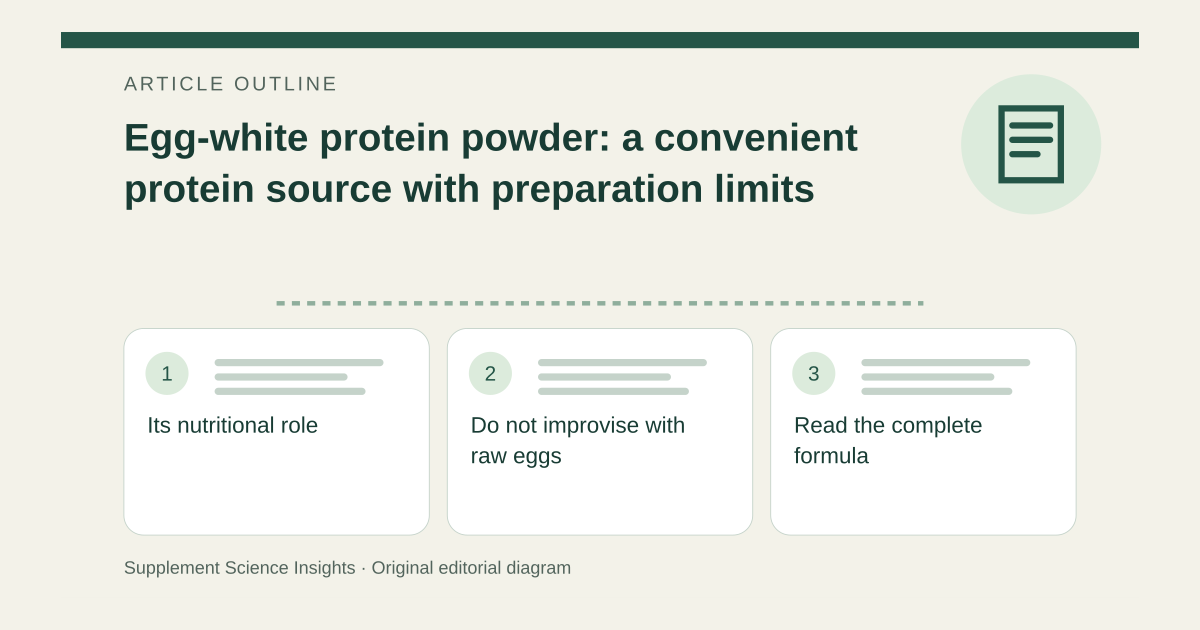
Its nutritional role
Eggs are a dietary protein source. A powder made from egg white can offer convenience, but the useful amount depends on its declared protein and the rest of the diet. Adequate protein supports tissue maintenance and training adaptation; the source name alone does not show that a supplement is needed or better than suitable foods. [1][2]
Do not improvise with raw eggs
FDA recommends treated eggs or pasteurized egg products for recipes served raw or undercooked. Do not assume that drying raw egg at home produces an equivalent ready-to-drink powder. Use a commercial product according to its intended preparation and storage instructions; if it requires cooking, simply stirring it into a cold shake does not satisfy that direction. [3]
Read the complete formula
Imagine a serving weighs 30 g and declares 24 g protein. Two-thirds of that serving weighs 20 g and supplies 16 g protein by the label calculation. Other ingredients and dietary restrictions still matter: egg protein is not suitable for someone who must avoid egg. This example compares amounts, not a personalized dose or a guarantee of product safety. [2]
| Hypothetical label or direction | Meaning |
|---|---|
| 30 g powder / 24 g protein | Powder is not entirely protein |
| 20 g powder | 16 g declared protein |
| Requires cooking | Not interchangeable with a ready-to-drink product |
Sources for this article
- Protein in diet: MedlinePlus Medical Encyclopedia
Source consulted: 2026-09-20. This is a reference resource, not a claim that we conducted the studies or tested a product. - Dietary Supplements for Exercise and Athletic Performance - Health Professional Fact Sheet
Source consulted: 2026-09-20. This is a reference resource, not a claim that we conducted the studies or tested a product. - What You Need to Know About Egg Safety | FDA
Source consulted: 2026-09-20. This is a reference resource, not a claim that we conducted the studies or tested a product.