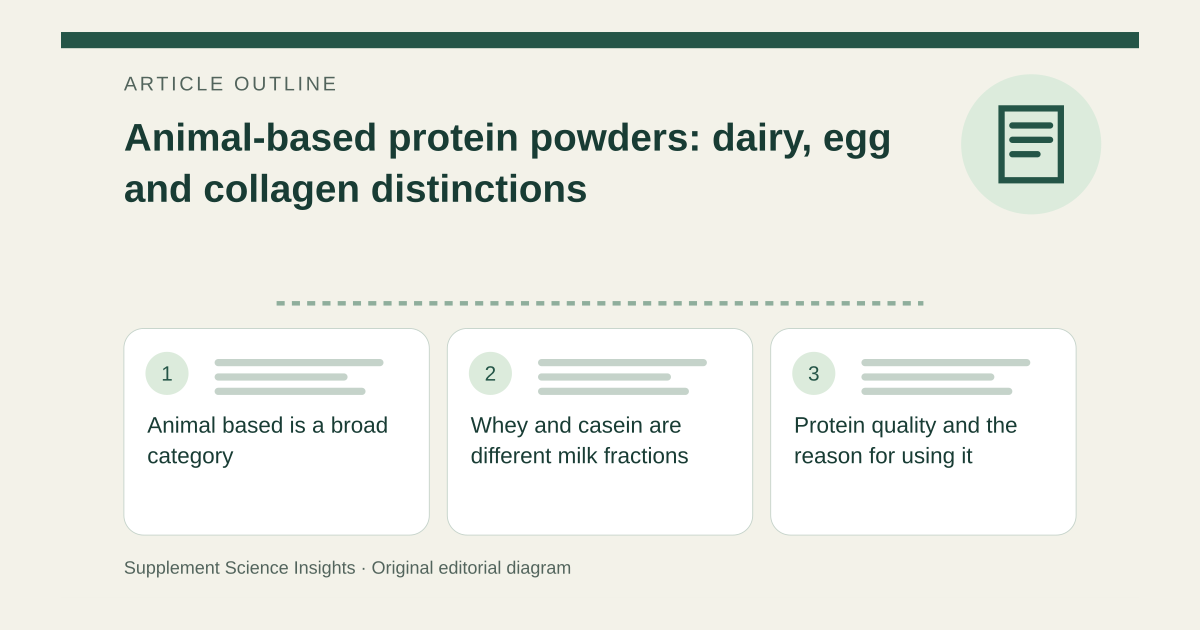
Animal based is a broad category
Animal-derived protein powders include milk proteins such as whey and casein, egg-derived powders and proteins obtained from other animal tissues. The category identifies origin, not one standardized amino-acid profile or one degree of processing. [1][2]
A powder's name should tell you more than whether it came from an animal. Check the specific protein ingredient, protein amount per serving and other ingredients. A scoop's weight includes everything in the mixture, so equal scoop weights do not necessarily supply equal amounts of protein. [1][2]
Whey and casein are different milk fractions
Whey and casein are both milk proteins. U.S. Dairy describes their separation and use as dried ingredients, and notes differences in digestion rate and composition. Whey is commonly described as faster-digested and casein as slower-digested. [3][2]
Those distinctions are not a universal ranking of usefulness. Total dietary protein, the food pattern and the purpose of supplementation still matter. U.S. Dairy is an industry source here for dairy composition and processing; the broader exercise-nutrition context comes from NIH rather than a claim that all users need a dairy powder. [3][2]
Protein quality and the reason for using it
The body needs essential amino acids from food or supplements to support protein synthesis. NIH emphasizes both protein quality and quantity in exercise nutrition. Collagen-focused products have a different amino-acid pattern from milk or egg proteins and should not be assumed interchangeable solely because all are animal-derived. [2][1]
A powder can be a convenient way to add protein when needed, but convenience is not proof that it outperforms an adequate food-based diet. MedlinePlus also notes that animal foods are not required to obtain enough protein; plant foods can contribute to an adequate diet. [2][1]
A hypothetical serving comparison
Suppose a 30 g scoop of one blend supplies 20 g protein and a 30 g scoop of another supplies 25 g. The second supplies 5 g more protein per scoop in this example. That arithmetic does not settle quality, tolerability or whether either is needed, but it is more informative than comparing scoop size or the phrase animal based. [2]
| Hypothetical product | Declared protein |
|---|---|
| 30 g serving of blend A | 20 g |
| 30 g serving of blend B | 25 g |
| Difference | 5 g protein per serving |
Sources for this article
- Protein in diet: MedlinePlus Medical Encyclopedia
Source consulted: 2026-09-20. This is a reference resource, not a claim that we conducted the studies or tested a product. - Dietary Supplements for Exercise and Athletic Performance - Health Professional Fact Sheet
Source consulted: 2026-09-20. This is a reference resource, not a claim that we conducted the studies or tested a product. - Whey vs. Casein Protein: Difference Explained | U.S. Dairy
Source consulted: 2026-09-20. This is a reference resource, not a claim that we conducted the studies or tested a product.