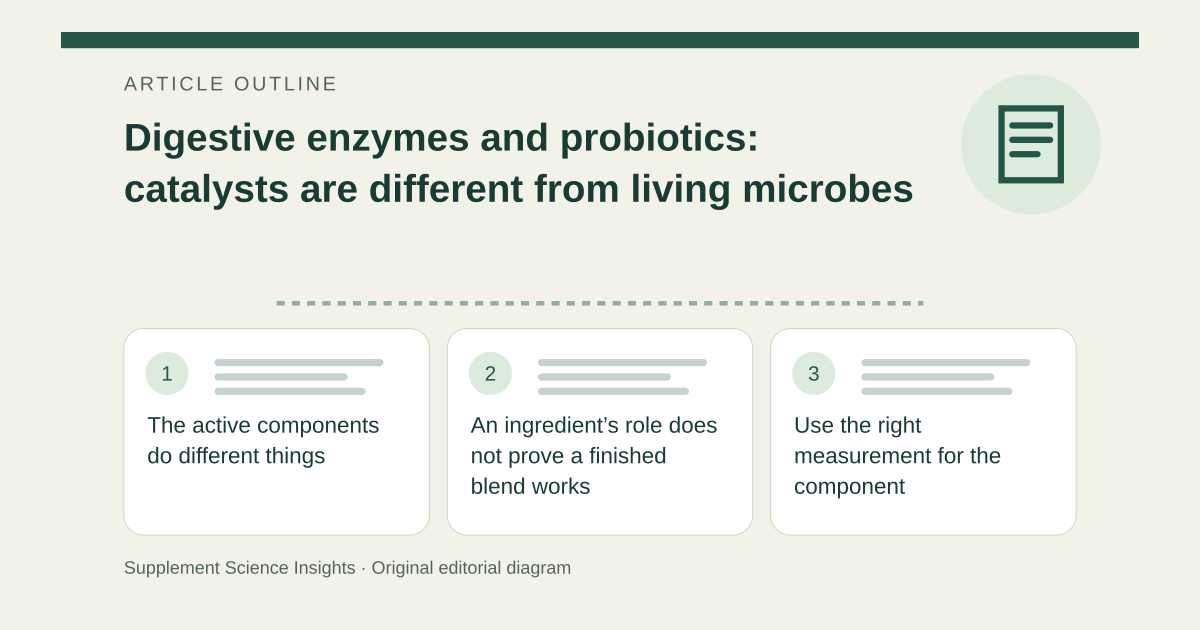
The active components do different things
Protein enzymes use a structured active site to act on particular substrates. Probiotics instead consist of living microorganisms; their identity and the evidence for the relevant use matter. [1][2]
Calling both digestive support does not erase this mechanistic difference. The same symptom can have several causes, so the marketing category does not identify which intervention is appropriate. [1][2]
An ingredient’s role does not prove a finished blend works
A clinical result for one enzyme preparation cannot be transferred to a probiotic, or vice versa. A blend needs evidence for its actual components and intended purpose rather than a claim that all digestive products are equivalent. [1][2]
This distinction also prevents confusing microbial viability with enzyme activity. A live culture count does not measure how much of a specific digestive reaction an enzyme preparation can catalyze. [1][2]
Use the right measurement for the component
Imagine a bottle lists both enzymes and live cultures. Its CFU figure describes the cultures, not the enzymes. Assess the separate ingredients and their evidence before interpreting the product’s overall claim.
| Detail | Interpretation |
|---|---|
| Enzyme | Catalyst |
| Probiotic | Living microorganism |
| Digestive support | Too broad to establish equivalence |
Sources for this article
- 6.5 Enzymes - Biology 2e | OpenStax
Source consulted: 2026-09-17. This is a reference resource, not a claim that we conducted the studies or tested a product. - Probiotics - Health Professional Fact Sheet
Source consulted: 2026-09-17. This is a reference resource, not a claim that we conducted the studies or tested a product.