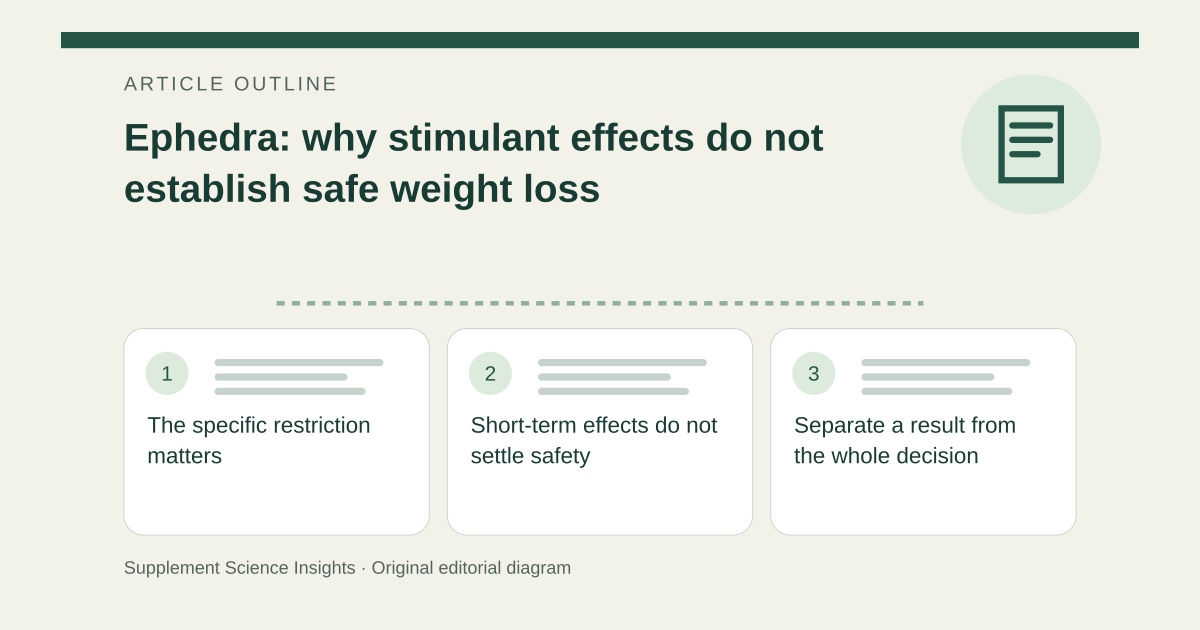
The specific restriction matters
NCCIH identifies ephedra, also called ma huang, as a plant historically used in herbal medicine. The U.S. restriction concerns dietary supplements containing ephedrine alkaloids. A claim that a product is “ephedra-free” needs to be read as a composition statement, not a safety certification. [1]
Short-term effects do not settle safety
NCCIH describes earlier research on short-term weight loss and harmful effects. Ephedra has been associated with high blood pressure, heart attack, stroke, seizures and psychiatric effects, including with relatively low doses or short use. A stimulant sensation is not evidence that the overall benefit outweighs those risks. [1]
Separate a result from the whole decision
Imagine a study reports a small change in weight but records serious adverse events. Reporting only the weight change would omit information essential to judging the intervention. The decision requires both outcomes and harms, including events too uncommon for a small trial to estimate reliably.
| What a reader sees | What it actually supports |
|---|---|
| Short-term weight change | Must be interpreted alongside adverse outcomes |
| “Ephedra-free” label | Describes absence of an ingredient, not overall safety |
A label is not a workaround
The cited U.S. ban took effect in 2004. This page does not recommend ephedra products or suggest substitutions intended to reproduce its stimulant effects. Review any weight-loss or energy blend by its complete ingredient list, rather than assuming removal of one ingredient establishes the safety of everything remaining. [1]
What evidence would be relevant
An advertisement should not use the absence of a prohibited ingredient as its main proof of effectiveness. Ask what was actually tested, in whom, for how long and with what adverse outcomes. Those questions still apply to a differently named formulation. No product comparison or affiliate recommendation is attached to this safety overview.
Sources for this article
- NCCIH — Ephedra
Source consulted: 2026-09-17. This is a reference resource, not a claim that we conducted the studies or tested a product.