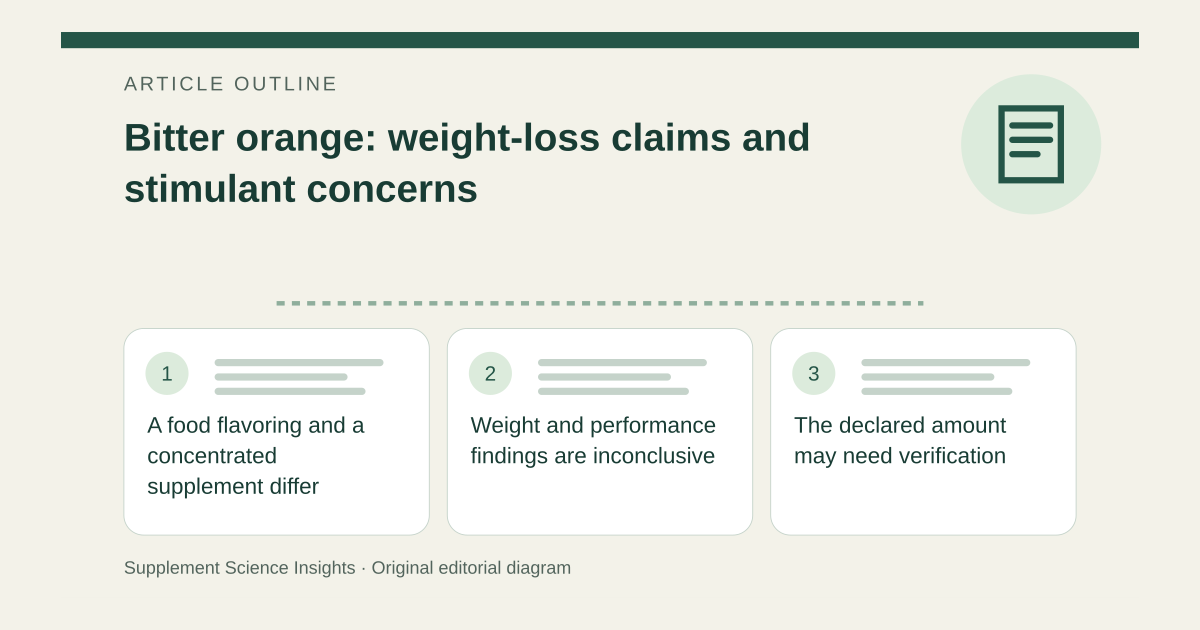
A food flavoring and a concentrated supplement differ
Bitter orange, Citrus aurantium, is used in foods and sold in concentrated supplements. Some products emphasize p-synephrine, a naturally occurring amine. Culinary exposure should not be equated with a concentrated extract or a multi-stimulant weight-loss formula. [1]
Record the botanical name, extract amount and any declared synephrine quantity. The amount of bitter-orange material is not automatically the amount of synephrine, and the front label may omit other relevant ingredients. [1]
Weight and performance findings are inconclusive
NCCIH finds no clear health benefit established for bitter orange. Weight-loss and exercise studies are often small, inconsistent or based on combinations. A study of a product containing caffeine and several other ingredients cannot identify bitter orange's independent effect. [1]
A short-term change in energy expenditure is also not the same as sustained weight loss. Duration, food intake, adherence and adverse effects all affect whether an intervention is useful outside a brief laboratory session. [1]
The declared amount may need verification
NCCIH describes an FDA analysis that found substantial labeling and composition problems in sampled bitter-orange supplements, including products with synthetic amines. That finding does not prove every product is adulterated, but it makes unsupported assumptions about identity particularly unhelpful. [1]
A label is a declaration, not an independent assay. If a certificate is offered, check that it concerns the actual finished product and batch rather than an unrelated raw material. [1]
Cardiovascular reports cannot be dismissed
Serious cardiovascular events have been reported with bitter-orange products, often containing several ingredients. Causation is therefore difficult to assign, but the uncertainty is not a safety clearance. Research on effects on blood pressure and heart rate is inconsistent. [1]
Discuss use with a clinician, especially when medicines or other stimulants are involved. Pregnancy and breastfeeding safety is also a concern. No expected weight-loss benefit established here offsets those uncertainties. [1]
An extract percentage is not the whole exposure
Imagine a 200 mg extract declares 6 percent p-synephrine. The declared contribution is 12 mg. Another serving would double that label-based subtotal, but doing so is not recommended by this example.
A separate caffeine entry and other stimulants remain separate exposures; they cannot be ignored because the bitter-orange arithmetic is correct. If the synephrine percentage is absent, the extract weight alone does not establish its amount.
| Fictional declaration | Interpretation |
|---|---|
| 200 mg extract, 6% p-synephrine | 12 mg declared p-synephrine |
| Other stimulants in formula | Require separate assessment |
Uncertain benefit should remain visible
Avoid treating the phrase natural stimulant as evidence of either effectiveness or safety. A useful comparison needs the complete formula, reliable identity and a demonstrated outcome. This page explains the concerns without selecting a weight-loss regimen. For weight-loss claims, record whether participants also changed food intake or exercise. Otherwise, the product may receive credit for changes the study did not isolate.
Sources for this article
- NCCIH — Bitter orange: Usefulness and Safety
Source consulted: 2026-09-17. This is a reference resource, not a claim that we conducted the studies or tested a product.