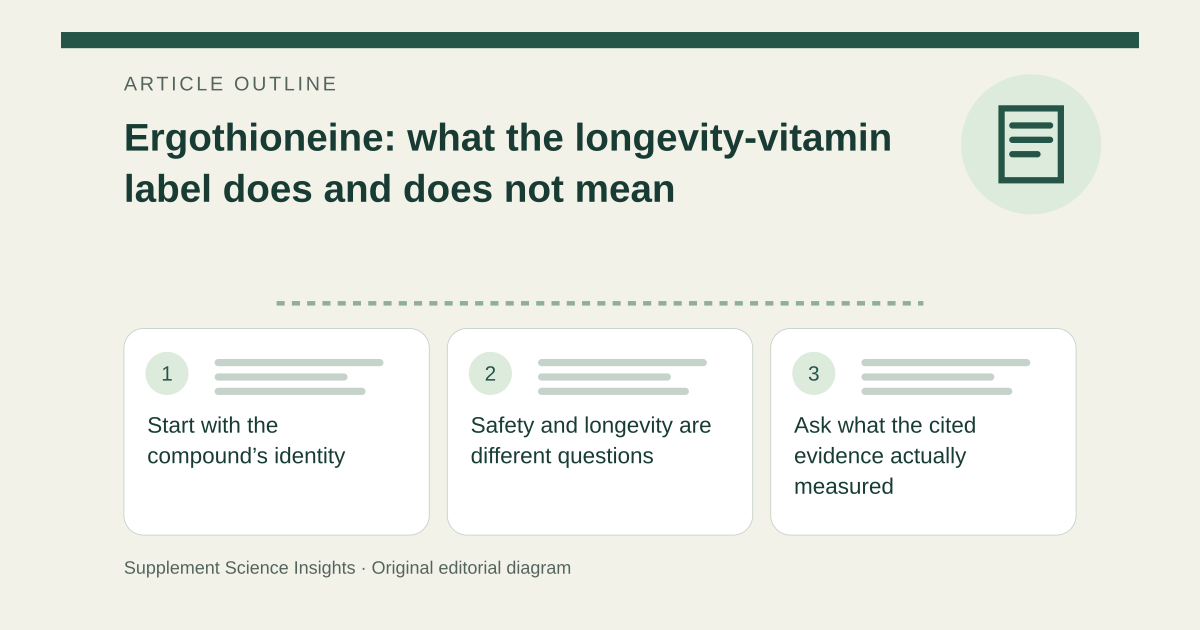
Start with the compound’s identity
ChEBI describes ergothioneine as a histidine-derived metabolite synthesized by bacteria and fungi, with antioxidant properties. EFSA notes its presence in foods including mushrooms and some beans. These statements explain identity and occurrence, not a prescribed daily requirement. [1][2]
Safety and longevity are different questions
EFSA’s 2016 opinion evaluated a particular synthetic ingredient under specified intended uses. It was a safety assessment, not a trial demonstrating longer life. Calling a compound a longevity vitamin should not be read as proof of an established deficiency syndrome, required supplement dose or lifespan benefit. [2][1]
Ask what the cited evidence actually measured
Imagine a supplement cites the EFSA opinion alongside an anti-aging claim. Check whether the source evaluates safety, a laboratory property or a human health outcome. None of those categories can be silently substituted for a controlled demonstration of longer healthy life. [2]
| Claim or number | What it establishes |
|---|---|
| Antioxidant property | Chemical/biological role |
| Ingredient safety opinion | Applies to defined uses |
| Longer human lifespan | Requires separate outcome evidence |
Sources for this article
- Ergothioneine CHEBI:4828 — EMBL-EBI
Source consulted: 2026-09-20. This is a reference resource, not a claim that we conducted the studies or tested a product. - Safety of synthetic L-ergothioneine — EFSA 2016
Source consulted: 2026-09-20. This is a reference resource, not a claim that we conducted the studies or tested a product.