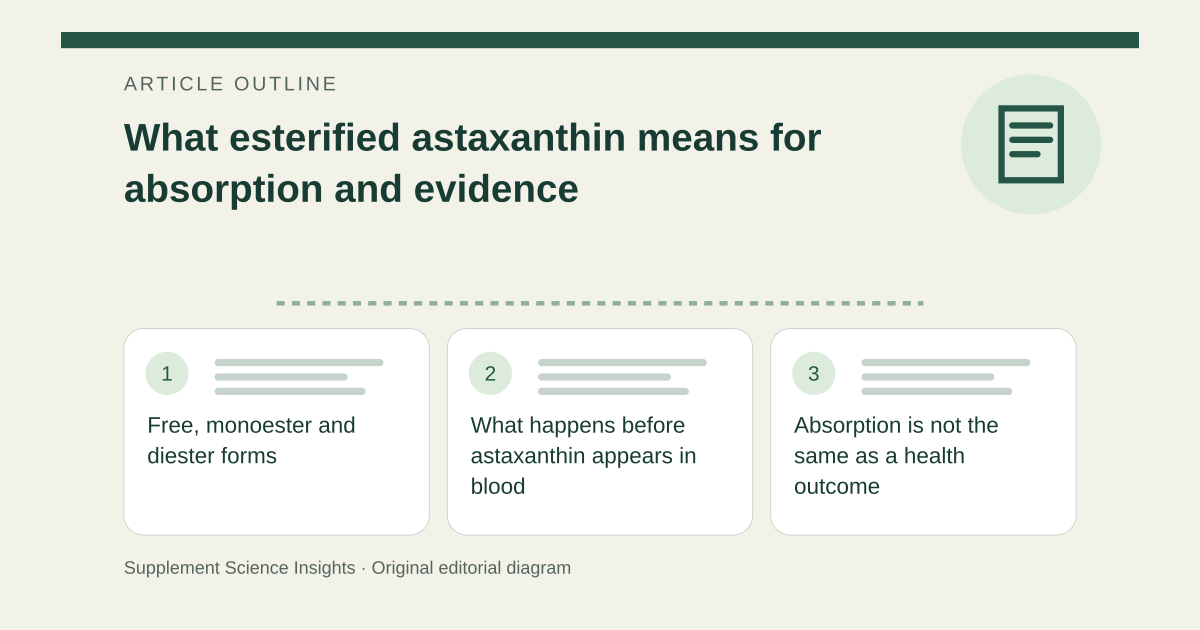
Free, monoester and diester forms
Astaxanthin is a carotenoid. In an esterified form, fatty-acid groups are chemically attached through ester bonds. A monoester has one such attachment and a diester has two. Free astaxanthin refers to the unesterified molecule, not a price or a guarantee of better quality. [1][2]
FDA documentation identifies Haematococcus pluvialis extracts containing astaxanthin esters. An extract's total weight, the amount of astaxanthin and its ester distribution are different quantities. A large number printed for an algal extract cannot automatically be read as the same number of milligrams of astaxanthin. [1][2]
What happens before astaxanthin appears in blood
A small original study examined plasma after three men aged 41–50 consumed meals containing astaxanthin diesters. They received two different single-dose exposures four weeks apart, and investigators sampled plasma over 76 hours. Astaxanthin esters were not detected in plasma; the findings were consistent with hydrolysis during absorption. [2]
This supports a chemical distinction between the administered ester and the form measured in circulation. It does not establish that esterified astaxanthin is better than every unesterified formulation. The study was tiny, did not assess a clinical benefit, and cannot determine long-term safety for a broad population. Its abstract does not supply enough information to independently assess funding or conflicts. [2]
Absorption is not the same as a health outcome
A blood-concentration result can show exposure under particular study conditions. It does not directly demonstrate improved vision, skin appearance, exercise recovery or another advertised benefit. Comparisons also need the same astaxanthin-equivalent amount and a clearly described food or oil vehicle. [2]
The small study reported a nonlinear dose response. That is another reason not to assume that multiplying an amount produces a proportional effect. The experimental quantities should not be turned into a personal dosing schedule. [2]
Keep the safety conclusion within its scope
A GRAS notice concerns a specified ingredient and intended food uses. FDA's response referencing astaxanthin-ester notices is not approval of every supplement amount or every benefit claim. Ingredient source, formulation, exposure and user circumstances still matter. [1][2]
The evidence inspected here does not establish a general clinical advantage or a universal safe dose for esterified astaxanthin. That uncertainty should remain visible rather than being replaced by the word “natural” or an absorption claim. [1][2]
Comparing two hypothetical specifications
Suppose one specification reports extract weight and another reports astaxanthin equivalents. Obtain the corresponding astaxanthin amount for both before comparing them. Then distinguish the ester profile from any human outcome evidence; neither entry alone establishes the better supplement. [1]
| Quantity | Meaning |
|---|---|
| Algal extract mass | All material in the described extract |
| Astaxanthin-equivalent amount | The astaxanthin amount used for comparison |
| Ester distribution | How much is present in different attached forms |
Sources for this article
- FDA has no questions- Agency Response Letter GRAS Notice No. GRN 000700
Source consulted: 2026-09-20. This is a reference resource, not a claim that we conducted the studies or tested a product. - Plasma appearance of unesterified astaxanthin geometrical E/Z and optical R/S isomers in men given single doses of a mixture of optical 3 and 3'R/S isomers of astaxanthin fatty acyl diesters.
Source consulted: 2026-09-20. This is a reference resource, not a claim that we conducted the studies or tested a product.