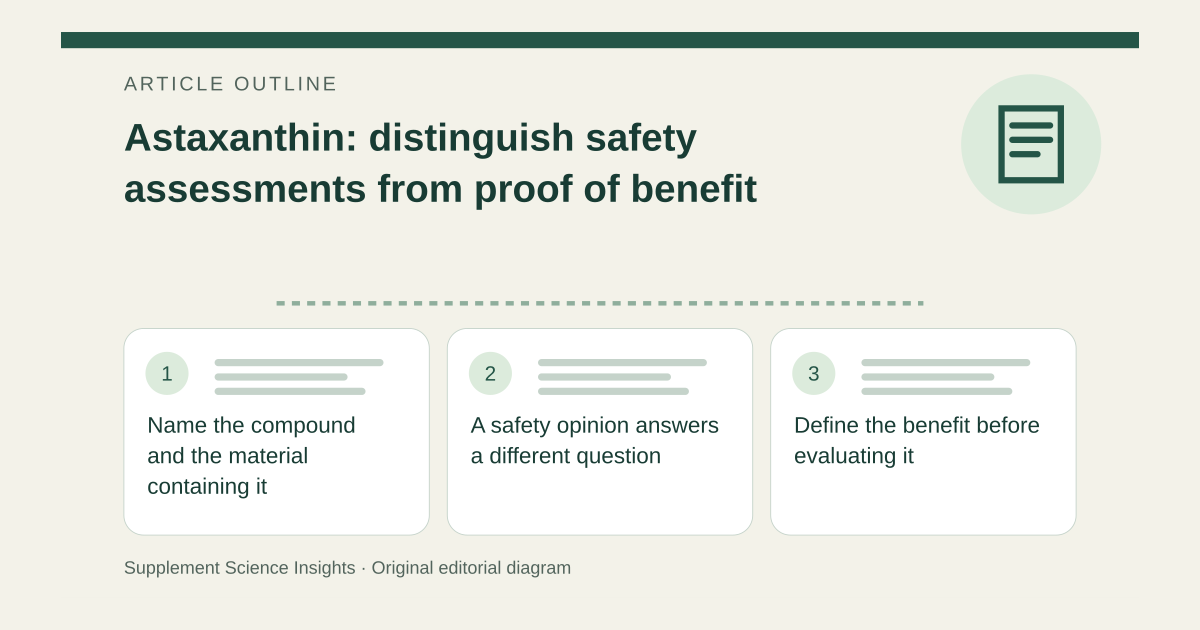
Name the compound and the material containing it
Astaxanthin is a carotenoid found in products including algae-derived preparations. A label may list an oleoresin or extract amount as well as the amount of astaxanthin itself. Those numbers describe different quantities and should not be combined. [1]
A safety assessment of a defined material does not automatically cover every source, formulation or mixture. The specification and intended exposure are part of the assessment rather than optional details beneath a familiar ingredient name. [1]
A safety opinion answers a different question
EFSA's 2020 opinion examined astaxanthin exposure from supplements alongside intake from food. Its purpose was safety assessment, not proof of effectiveness for a health outcome. Citing that opinion as evidence that a product improves vision, skin or exercise performance would misrepresent its scope. [1][2]
An earlier EFSA opinion did not substantiate certain submitted health claims from the evidence provided. That historical assessment is not a complete review of every later study; its date and the specific claims assessed should remain explicit. [1][2]
Define the benefit before evaluating it
A skin claim could concern hydration, appearance, redness after ultraviolet exposure or a medical outcome. These are different endpoints. A muscle claim could concern strength, fatigue or recovery. A vague antioxidant category cannot identify which question a trial answered.
For any newer study, check the population, formulation, comparator and outcome directly. If a blend includes other carotenoids or vitamins, its result does not isolate astaxanthin. A chemically plausible explanation is useful background, but it does not replace a controlled human comparison.
An exposure boundary is not a target dose
A safety evaluation considers a defined amount, population and other sources of exposure. It should not be read as a recommendation that everyone needs that amount or that larger servings are necessarily acceptable. [1]
EFSA's assessment specifically considered combined intake and age-related exposure differences. This overview does not supply a universal safe dose or a regimen for children, pregnancy or medical treatment. The exact product and clinical context require their own consideration rather than borrowing a general regulatory citation. [1]
Calculate the constituent rather than the carrier
Imagine a fictional serving lists 80 mg algal oleoresin standardized to 5 percent astaxanthin. The declared astaxanthin amount is 4 mg. Calling the product an 80 mg astaxanthin serving would overstate that quantity twentyfold.
The calculation establishes composition only. It does not show that 4 mg produces a particular benefit or is appropriate for an individual reader.
| Fictional declaration | Correct reading |
|---|---|
| 80 mg oleoresin; 5% astaxanthin | 4 mg astaxanthin |
| 80 mg astaxanthin claim | Twentyfold overstatement |
| Safety assessment cited | Not proof of benefit |
A citation should support the claim actually made
This page does not recommend astaxanthin as an oral sunscreen or an anti-aging treatment. Separate identity, safety and effectiveness evidence, and retain the date and scope of each assessment. A well-described ingredient can still have an unresolved clinical claim.
Sources for this article
- EFSA — Safety of astaxanthin for use in food supplements (2020)
Source consulted: 2026-09-17. This is a reference resource, not a claim that we conducted the studies or tested a product. - EFSA — Astaxanthin health-claim assessment (2011), historical scope
Source consulted: 2026-09-17. This is a reference resource, not a claim that we conducted the studies or tested a product.