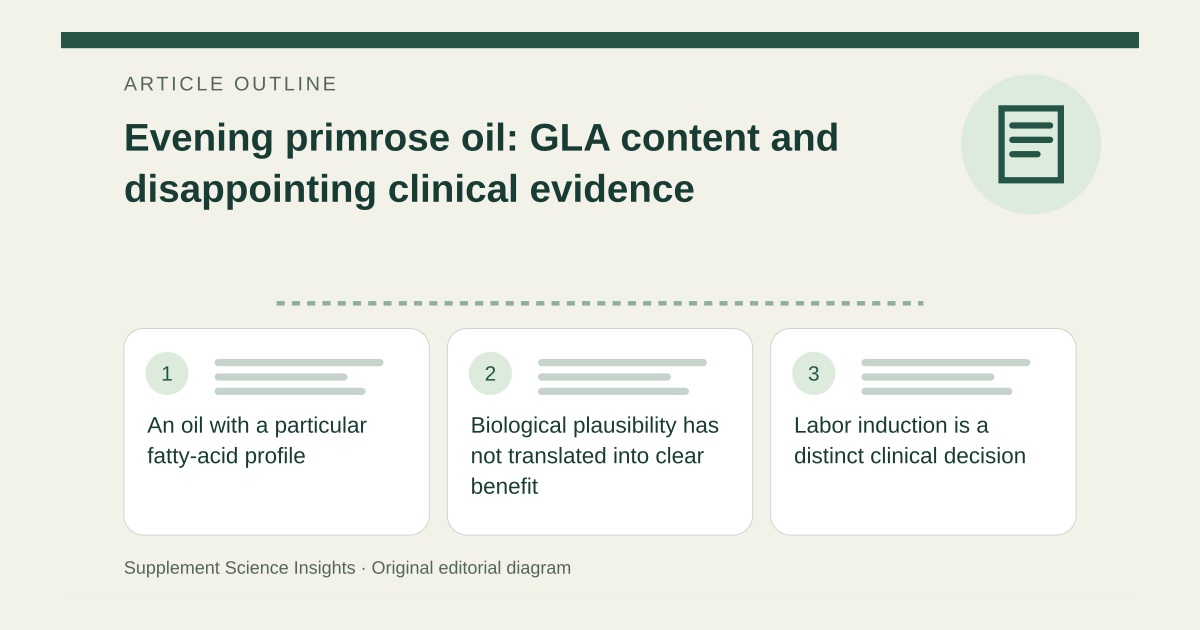
An oil with a particular fatty-acid profile
Evening primrose oil comes from seeds of Oenothera biennis and contains gamma-linolenic acid, usually abbreviated GLA. It is an omega-6 fatty acid, not the same compound as the alpha-linolenic acid often abbreviated ALA in flaxseed products. [1]
The total oil amount and the GLA amount are different quantities. A large oil serving does not establish a particular GLA exposure unless the composition is declared or measured. [1]
Biological plausibility has not translated into clear benefit
NCCIH finds insufficient evidence to support evening primrose oil for a health condition. Oral use has not been shown helpful for atopic dermatitis, and it is probably no better than placebo for breast pain. Evidence for other claims remains limited or inconsistent. [1]
A plausible role in inflammatory pathways is not a substitute for those clinical results. When a theory and a trial outcome differ, the theory should not be used to erase the outcome. [1]
Labor induction is a distinct clinical decision
Evening primrose oil has been studied by oral and vaginal routes in attempts to start labor, with inconsistent results and unresolved long-term safety. This is not an ordinary supplement-comparison question. [1]
A pregnancy-related decision should be made with the maternity-care team. Evidence from one route cannot be transferred to another, and a product sold as a capsule does not establish that it is suitable for vaginal use. [1]
When comparing fatty-acid products, write out the ingredient names at least once. Similar abbreviations can conceal different molecules, and a shared word such as linolenic does not establish the same nutritional or clinical role. [1]
Tolerance is not evidence of effectiveness
Common reported adverse effects include abdominal discomfort, nausea and diarrhea. Information in children and some pregnancy or breastfeeding settings is limited. Medicines and the complete product should be reviewed with the treating clinician. [1]
Even if a preparation is tolerated, it may not deliver the hoped-for benefit. That distinction is useful when considering continued expense or when a supplement distracts from an established treatment for a persistent skin or pain condition. [1]
Calculate GLA only when its proportion is known
Imagine a fictional oil serving is 1,000 mg and declares 9 percent GLA. The declared GLA quantity is 90 mg. Another 1,000 mg oil product without a GLA declaration cannot automatically be assigned the same amount.
The calculation does not establish that 90 mg is effective or suitable for a reader. It simply preserves the difference between total oil mass and one component, avoiding a misleading comparison of headline numbers.
| Fictional declaration | GLA amount |
|---|---|
| 1,000 mg oil, 9% GLA | 90 mg |
| 1,000 mg oil, composition absent | Unknown |
A negative or uncertain finding is still useful
A careful reference can explain what an oil contains while acknowledging that familiar claims are not established. This page does not recommend evening primrose oil for eczema, breast pain or pregnancy care, and it does not rank products by GLA percentage alone.
Sources for this article
- NCCIH — Evening primrose oil: Usefulness and Safety
Source consulted: 2026-09-17. This is a reference resource, not a claim that we conducted the studies or tested a product.