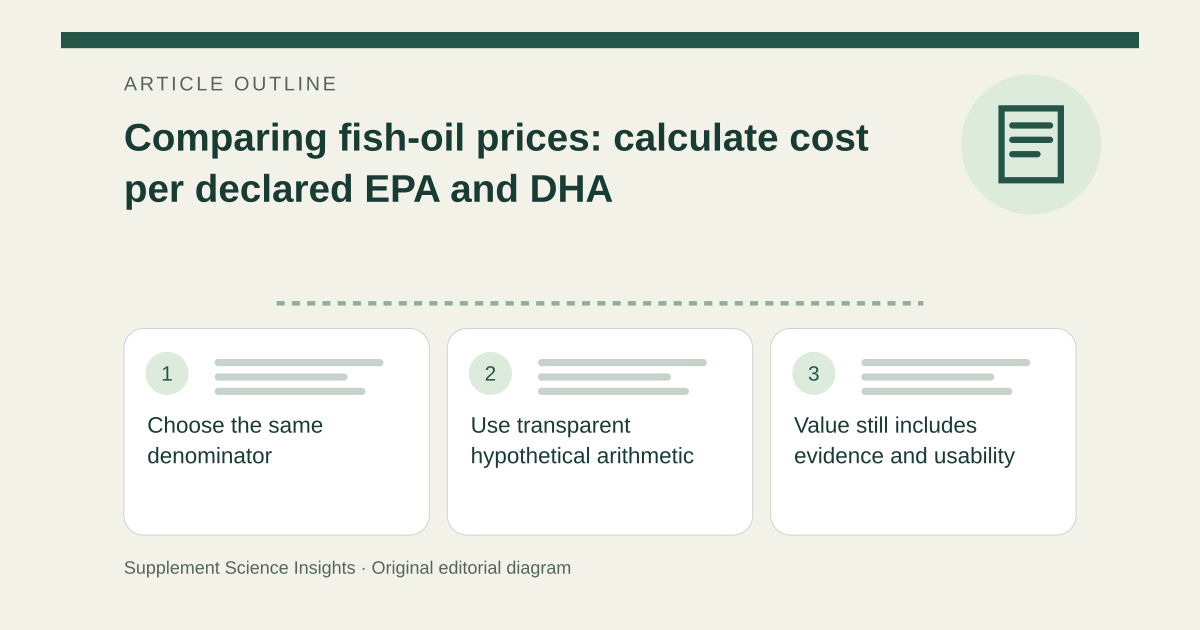
Choose the same denominator
Find EPA plus DHA per serving and the number of servings in the package. Multiply to estimate total declared EPA/DHA, then divide the price by that amount. A comparison per gram of total fish oil answers a different question and can favor a dilute product unintentionally. [1][2]
Use transparent hypothetical arithmetic
Imagine a $20 bottle has 100 servings containing 300 mg combined EPA/DHA each. It provides 30,000 mg, or 30 g, at about $0.67 per gram. A $24 bottle with 60 servings of 600 mg provides 36 g, also about $0.67 per gram. These are examples, not current prices or recommended intakes. [1]
Value still includes evidence and usability
Equal cost per gram does not make products equivalent in quality, formulation, tolerability or fit with a clinical plan. Check the exact ingredient, storage and testing information. A lower unit price is useful only after the product and amount are appropriate; it does not justify taking more. [3]
| Illustration | Interpretation |
|---|---|
| $20 ÷ 30 g | About $0.67/g EPA plus DHA |
| $24 ÷ 36 g | About $0.67/g EPA plus DHA |
| Same unit price | Not proof of equivalent quality |
Sources for this article
- Omega-3 Fatty Acids - Health Professional Fact Sheet
Source consulted: 2026-09-20. This is a reference resource, not a claim that we conducted the studies or tested a product. - Questions and Answers on Dietary Supplements | FDA
Source consulted: 2026-09-20. This is a reference resource, not a claim that we conducted the studies or tested a product. - Dietary Supplements: What You Need to Know
Source consulted: 2026-09-20. This is a reference resource, not a claim that we conducted the studies or tested a product.