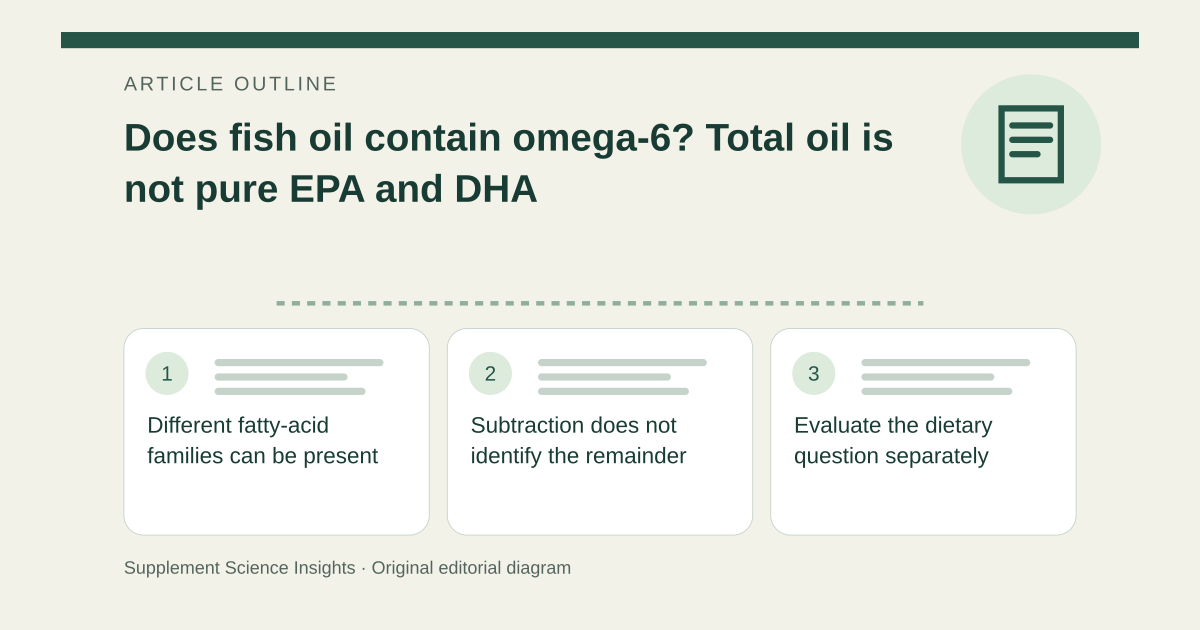
Different fatty-acid families can be present
Omega-3 and omega-6 describe chemical families, not mutually exclusive categories of whole oils. A fish-oil ingredient can contain several fatty acids. The exact omega-6 amount requires a product-specific composition statement or analysis rather than inference from the words fish oil. [1]
Subtraction does not identify the remainder
If a serving lists 1,000 mg fish oil with 300 mg EPA plus DHA, the remaining 700 mg is not automatically omega-6. It can include other lipid components and fatty acids. The label’s silence about a particular fatty acid is not a measured zero or proof that all unlisted mass belongs to it. [1]
Evaluate the dietary question separately
Imagine a user wants to avoid an oil because it contains any omega-6. Linoleic acid is an essential fatty acid, and ODS does not define one optimal omega-6-to-omega-3 ratio for everyone. Assess the whole dietary pattern and the intended EPA/DHA contribution rather than treating a small unspecified fraction as inherently harmful. [1]
| Illustration | Interpretation |
|---|---|
| 1,000 mg total oil | The complete oil amount |
| 300 mg EPA plus DHA | Two identified fractions |
| 700 mg remainder | Not automatically all omega-6 |
Sources for this article
- Omega-3 Fatty Acids - Health Professional Fact Sheet
Source consulted: 2026-09-20. This is a reference resource, not a claim that we conducted the studies or tested a product.