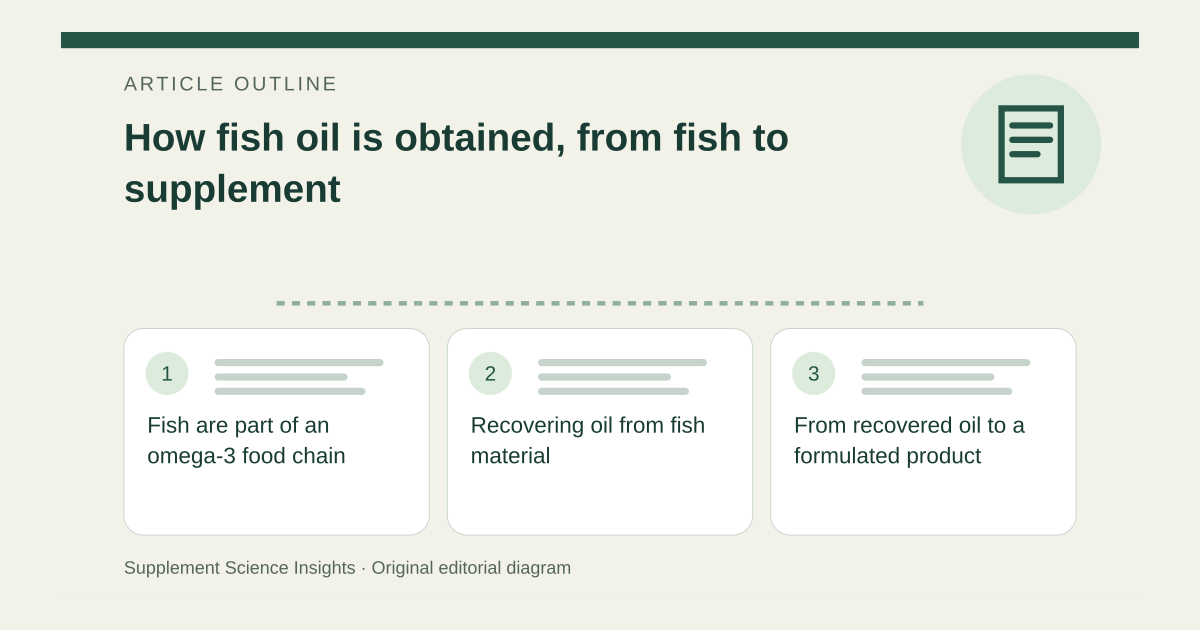
Fish are part of an omega-3 food chain
Fish oil comes from oily fish material, but the marine EPA and DHA ultimately originate in microalgae and move through the food chain. Fish accumulate these fatty acids in their tissues. This explains the connection between fish oil and algal oil without making the two finished products identical. [1]
The species, source material and processing affect the starting oil. A general fish-oil name does not specify its EPA and DHA concentration, whether it came from body tissue or liver, or its finished quality. [1]
Recovering oil from fish material
FAO describes a conventional process that separates fish material into solids, oil and water. Heating coagulates proteins and releases oil and water. Pressing or centrifugation separates liquid from much of the solid material, after which further separation recovers the oil fraction. [2]
Oil polishing removes remaining impurities before storage at that processing stage. This industrial account describes recovery of fish oil; it is not proof that the oil leaving a particular factory is already a finished human supplement. Additional processing and product specifications need their own documentation. [2]
From recovered oil to a formulated product
Supplement oils can be supplied in different chemical forms, including triglycerides and ethyl esters. NIH discusses those forms separately from their source. A capsule may also contain a carrier or other ingredients, so its total oil amount is not necessarily all EPA and DHA. [1]
Cod liver oil is another distinct product: it can supply vitamins A and D in addition to long-chain omega-3s. That composition should not be assumed for ordinary fish-body oil, nor should a fish-oil amount be substituted for the vitamin amounts on a liver-oil label. [1]
What a consumer can actually compare
Use the declared EPA and DHA per serving, serving size and actual product-quality evidence. The word “purified” does not provide a complete test report, and the extraction method alone does not show clinical benefit. A study of a specific omega-3 preparation does not automatically apply to every product made from fish. [2][1]
The FAO processing document and NIH nutrition summary answer different parts of this chain. Together they explain origin and formulation, without certifying a particular brand or offering a home extraction procedure. [2][1]
A hypothetical oil-label calculation
A fictional serving contains 1,000 mg of fish oil, with 180 mg EPA and 120 mg DHA. EPA plus DHA totals 300 mg, not 1,000 mg. The remaining mass belongs to other components of the oil and formulation. Use the 300 mg figure when the comparison specifically asks for EPA plus DHA. [1]
| Component | Hypothetical amount |
|---|---|
| Total fish oil | 1,000 mg |
| EPA plus DHA | 180 + 120 = 300 mg |
| Other oil components | 700 mg by subtraction |
Sources for this article
- Omega-3 Fatty Acids - Health Professional Fact Sheet
Source consulted: 2026-09-20. This is a reference resource, not a claim that we conducted the studies or tested a product. - The production of fish meal and oil - 3. The process
Source consulted: 2026-09-20. This is a reference resource, not a claim that we conducted the studies or tested a product.