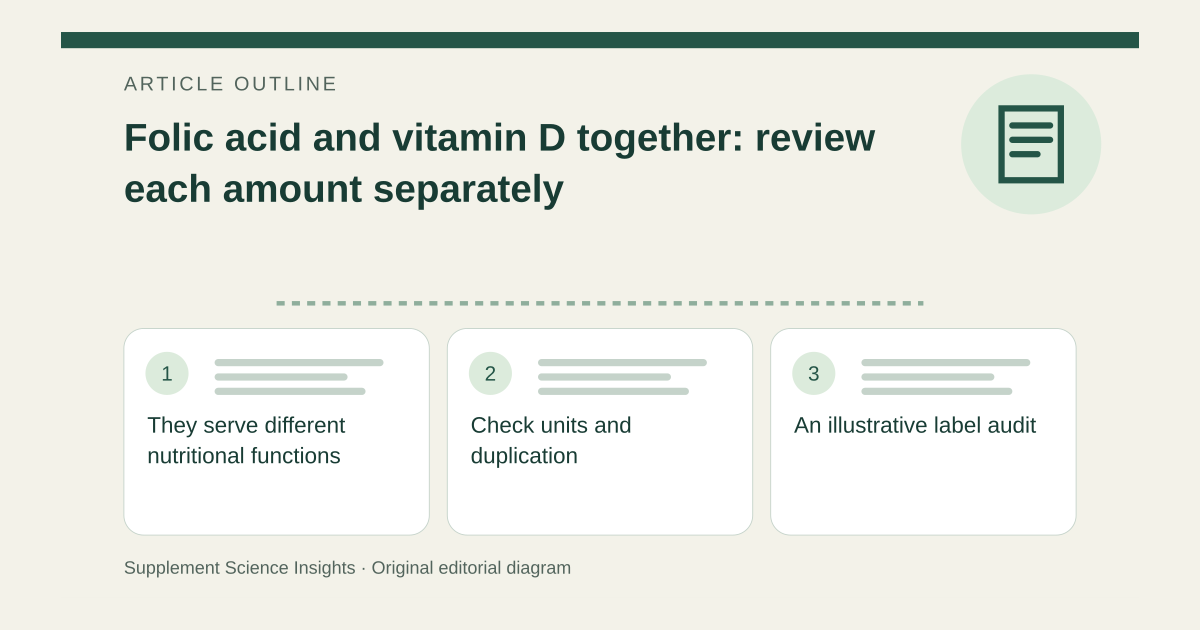
They serve different nutritional functions
Folate participates in one-carbon metabolism and cell division; vitamin D helps regulate calcium and supports bone health. Those roles do not create a fixed combined dose. A product containing both should still declare each nutrient separately, and prescribed treatment can differ from routine nutritional intake. [1][2]
Check units and duplication
Folate labels can use dietary folate equivalents as well as a parenthetical folic acid amount. These are related measurements, not two ingredients to add together. Vitamin D may be expressed in micrograms and IU. Count overlapping multivitamins and separate supplements before deciding another product is needed. Large folic acid intake also needs attention to vitamin B12 status. [1][2]
An illustrative label audit
Imagine a multivitamin provides 400 mcg folic acid and 25 mcg vitamin D, and a second product adds another 25 mcg D. The D total is 50 mcg, equivalent to 2,000 IU. That arithmetic does not establish that this combination is appropriate for every person. Pregnancy, medicines, deficiency treatment and medical conditions require their own assessment. [1][2]
| Hypothetical label information | Interpretation |
|---|---|
| Folate DFE and parenthetical folic acid | Different expressions; do not double-count |
| 25 mcg D + 25 mcg D | 50 mcg D |
| 50 mcg vitamin D | 2,000 IU |
Sources for this article
- Folate - Health Professional Fact Sheet
Source consulted: 2026-09-20. This is a reference resource, not a claim that we conducted the studies or tested a product. - Vitamin D - Health Professional Fact Sheet
Source consulted: 2026-09-20. This is a reference resource, not a claim that we conducted the studies or tested a product.