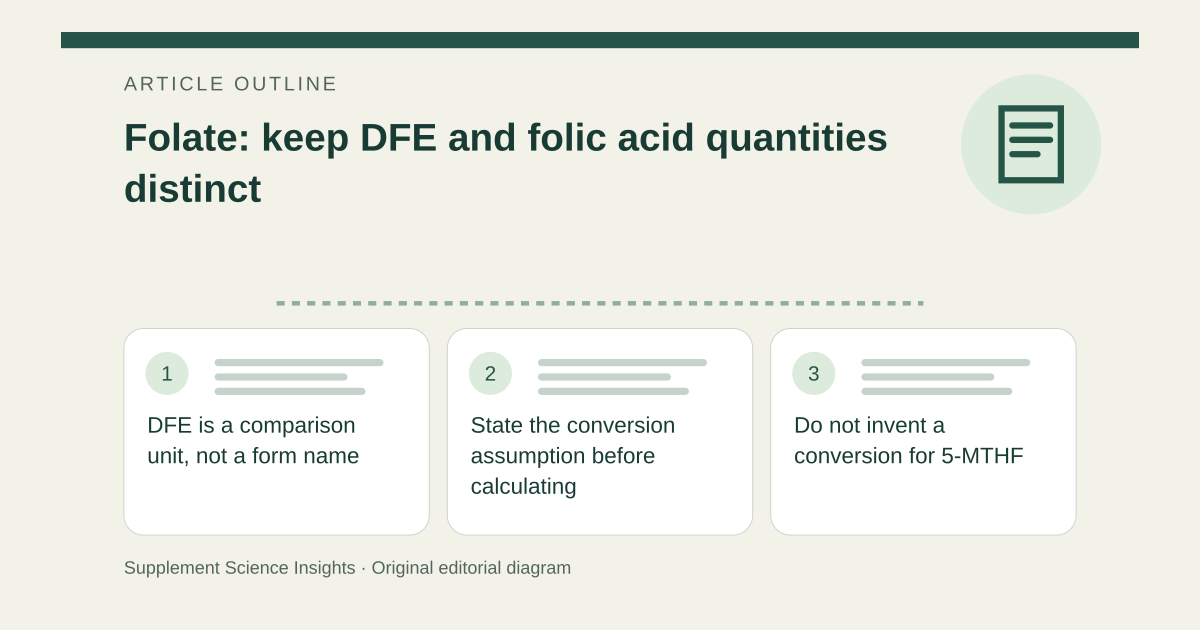
DFE is a comparison unit, not a form name
Dietary folate equivalents, abbreviated DFE, account for differences in bioavailability. NIH ODS distinguishes food folate from folic acid and specifies different conversions depending on whether folic acid is taken with food. The form and context therefore matter. [1]
Copy the complete label entry, including any parenthetical quantity and named form. Do not discard the unit when transferring a number into notes. A field labeled only “folate amount” can hide differences the original label made explicit. [1]
State the conversion assumption before calculating
For this teaching example, use the ODS relationship that 0.6 micrograms of folic acid consumed with food corresponds to 1 microgram DFE. An invented 120-microgram folic-acid amount under that assumption corresponds to 200 micrograms DFE: 120 divided by 0.6. [1]
An invented 200-microgram amount of food folate also corresponds to 200 micrograms DFE. The equal DFE values do not mean equal chemical mass. These examples are not suggested intakes or manufacturer label-rounding instructions, and they should not be extrapolated to another form. [1]
| Input | Assumption | Result |
|---|---|---|
| 120 micrograms folic acid | Consumed with food; divide by 0.6 | 200 micrograms DFE |
| 200 micrograms food folate | One-to-one DFE relationship | 200 micrograms DFE |
| Supplemental 5-MTHF | No formally established conversion factor in ODS | Do not apply this example |
Do not invent a conversion for 5-MTHF
ODS states that conversion factors between micrograms and DFE for supplemental 5-MTHF have not been formally established. A folic-acid calculation therefore should not be presented as a validated conversion for every methylfolate product. [1]
If a label supplies both a DFE entry and a form quantity, preserve both as manufacturer declarations. If a relationship is unclear, ask for the basis rather than reverse-engineering a universal rule from one bottle. A genetic marketing claim does not resolve missing label information. [1]
Keep B12 and medicine questions in view
High folate intake can correct the anemia of B12 deficiency without addressing its neurological damage. Folate supplements can also interact with medicines, including methotrexate and certain antiseizure treatments. Methotrexate advice depends on the condition and regimen. [1]
Discuss supplementation with the treating clinician. Do not start, stop or change an established folate prescription based on this worksheet. For pregnancy planning, obtain current clinical guidance rather than treating the invented conversion as a prenatal recommendation. [1]
Make a record that can be checked later
Use separate fields for the declared DFE, stated folic acid or other form, serving size, directions and source date. Keep screenshots complete enough to show which number belongs to which field. Record missing information as missing.
Before combining entries from multiple products, check their units and form declarations. If they are not comparable, leave separate rows and explain why. A neat total built from incompatible entries is less useful than an honest incomplete record.
The arithmetic does not select a supplement
This page explains a specified conversion and its boundaries. It does not rank folate forms, interpret a genetic test or prescribe an intake for pregnancy, anemia or another condition.
The linked government synthesis supports the background distinctions. No individual trial or retail batch has been independently appraised for this article. A clinical recommendation would require a different review question and qualified assessment.
Sources for this article
- NIH ODS — Folate: Health Professional Fact Sheet
Source consulted: 2026-09-17. This is a reference resource, not a claim that we conducted the studies or tested a product.