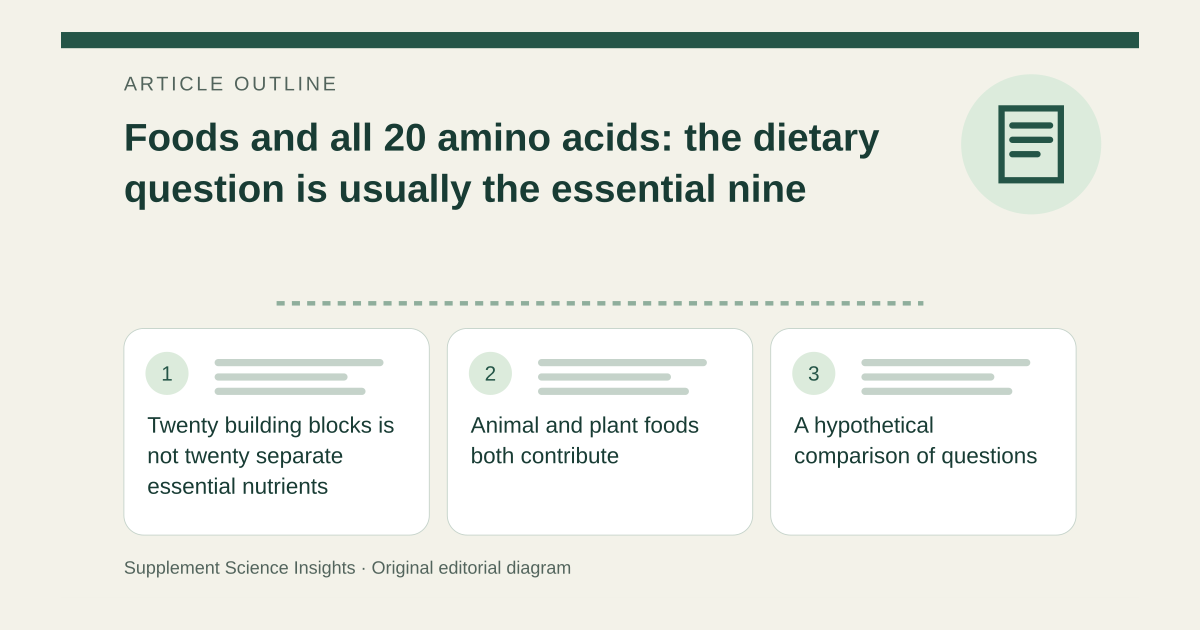
Twenty building blocks is not twenty separate essential nutrients
OpenStax describes proteins as polymers assembled from amino acids, while NIH ODS identifies nine essential amino acids that must be supplied in the diet. The body can make other amino acids under usual conditions. A claim that a food contains all 20 therefore does not by itself show that its portion meets an individual’s needs. [1][2]
Animal and plant foods both contribute
The selected USDA records for whole egg, soy protein isolate and boiled lentils all list the nine essential amino acids. Their concentrations and food portions differ considerably. These records do not individually resolve every one of the 20 amino acids as separate analytical fields; an absent field must not be interpreted as a proven absence from the food. [3]
A hypothetical comparison of questions
Imagine a label promises all 20 but supplies only 2 g protein per serving, while another food provides a larger useful protein contribution. The slogan alone does not choose the better fit. Ask about the quantity, essential-amino-acid profile, dietary context and tolerability, rather than requiring one ingredient to be the entire protein plan. [2]
| Question | Useful information |
|---|---|
| Which amino acids must come from diet? | The nine essential amino acids |
| Does a serving meet a need? | Quantity and dietary context |
| Is an analyte missing from a database? | Do not automatically treat a blank as zero |
Sources for this article
- 3.4 Proteins - Biology 2e | OpenStax
Source consulted: 2026-09-20. This is a reference resource, not a claim that we conducted the studies or tested a product. - Dietary Supplements for Exercise and Athletic Performance - Health Professional Fact Sheet
Source consulted: 2026-09-20. This is a reference resource, not a claim that we conducted the studies or tested a product. - USDA FoodData Central — SR Legacy April 2018 composition and portion tables
Source consulted: 2026-09-20. This is a reference resource, not a claim that we conducted the studies or tested a product.