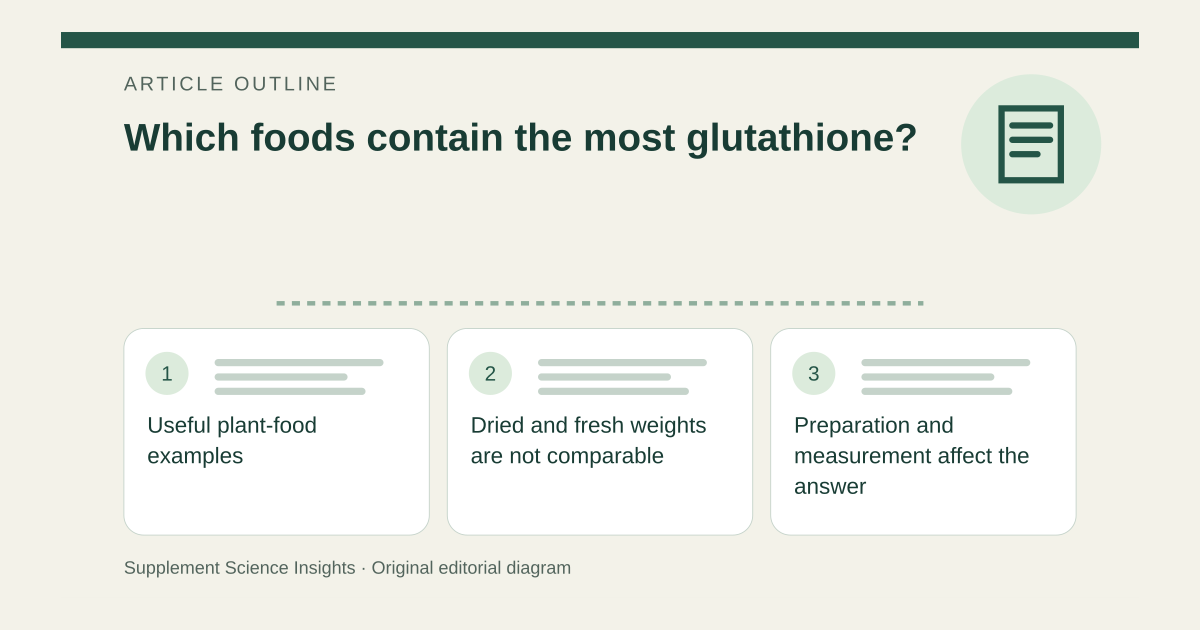
Useful plant-food examples
A dietary review lists asparagus, avocado, spinach, green beans and cucumber among glutathione-containing foods. In its selected plant-food table, asparagus, avocado and spinach rank above the other listed foods. This is a comparison within that dataset, not proof of the richest food worldwide. [1]
Dried and fresh weights are not comparable
A newer review includes mushrooms, legumes, meat and seafood. Its mushroom range refers to dried product, while other entries use different foods and tissue preparations. Removing water concentrates a value per 100 grams; that alone does not show a normal serving delivers more. [2]
Preparation and measurement affect the answer
Storage and processing can alter measured glutathione. Studies may distinguish reduced glutathione from total forms. Comparing figures without checking these details can create a misleading league table. Food safety and dietary variety still matter; raw animal foods are not a sensible shortcut. [2]
Food content is not a predicted blood increase
Imagine comparing fresh spinach with a dried mushroom powder. Compare equivalent serving sizes and the same measurement basis first. Even then, the food concentration does not establish absorption, a particular tissue change or a health benefit for the person eating it. [1][2]
| Check | Why |
|---|---|
| Fresh or dried | Water content changes concentration |
| Serving size | 100grams may not be realistic |
| Reduced or total | Different measures |
| Clinical result | Not inferred from food content |
Sources for this article
- A Review of Dietary (Phyto)Nutrients for Glutathione Support - PMC
Source consulted: 2026-09-21. This is a reference resource, not a claim that we conducted the studies or tested a product. - Glutathione in Our Diet and Its Role in the Body: From Disease Prevention to Anti-Aging - PMC
Source consulted: 2026-09-21. This is a reference resource, not a claim that we conducted the studies or tested a product.