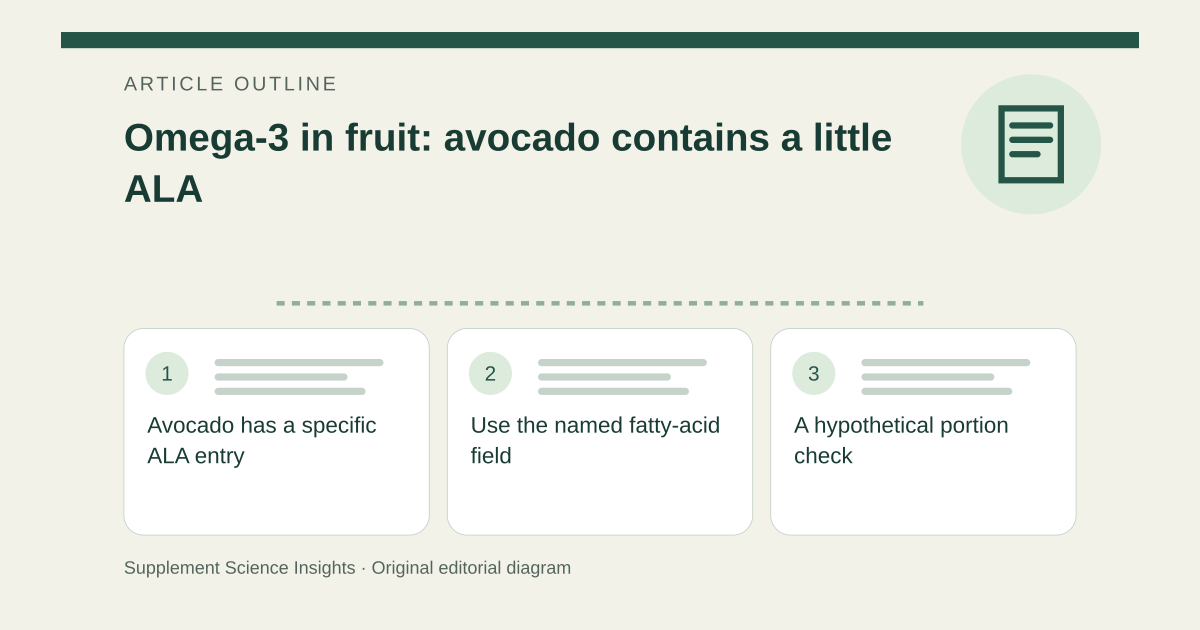
Avocado has a specific ALA entry
USDA SR Legacy lists raw avocado at 0.111 g ALA per 100 g, alongside 14.66 g total fat. A 50 g portion therefore provides about 0.056 g ALA. The much larger total-fat number does not represent omega-3. ODS identifies flaxseed, chia and walnuts among more concentrated plant ALA sources. [1][2]
Use the named fatty-acid field
Some older fruit records, including berry entries, report an undifferentiated 18:3 fatty-acid value rather than a separately identified ALA value. That field should not be promoted into a precise ranking of ALA or total omega-3 without additional composition information. Missing specificity is a data limit, not proof that the food contains none. [1]
A hypothetical portion check
A 100 g avocado portion gives twice the ALA estimate of a 50 g portion: 0.111 versus 0.056 g. ALA is a plant omega-3; ODS notes limited conversion to EPA and DHA. Equal gram amounts of different omega-3 forms therefore should not be treated as an interchangeable fish-oil dose. [1][2]
| Raw avocado | ALA estimate |
|---|---|
| 50 g | 0.056 g |
| 100 g | 0.111 g |
Sources for this article
- USDA FoodData Central — SR Legacy April 2018 composition and portion tables
Source consulted: 2026-09-20. This is a reference resource, not a claim that we conducted the studies or tested a product. - Omega-3 Fatty Acids - Health Professional Fact Sheet
Source consulted: 2026-09-20. This is a reference resource, not a claim that we conducted the studies or tested a product.