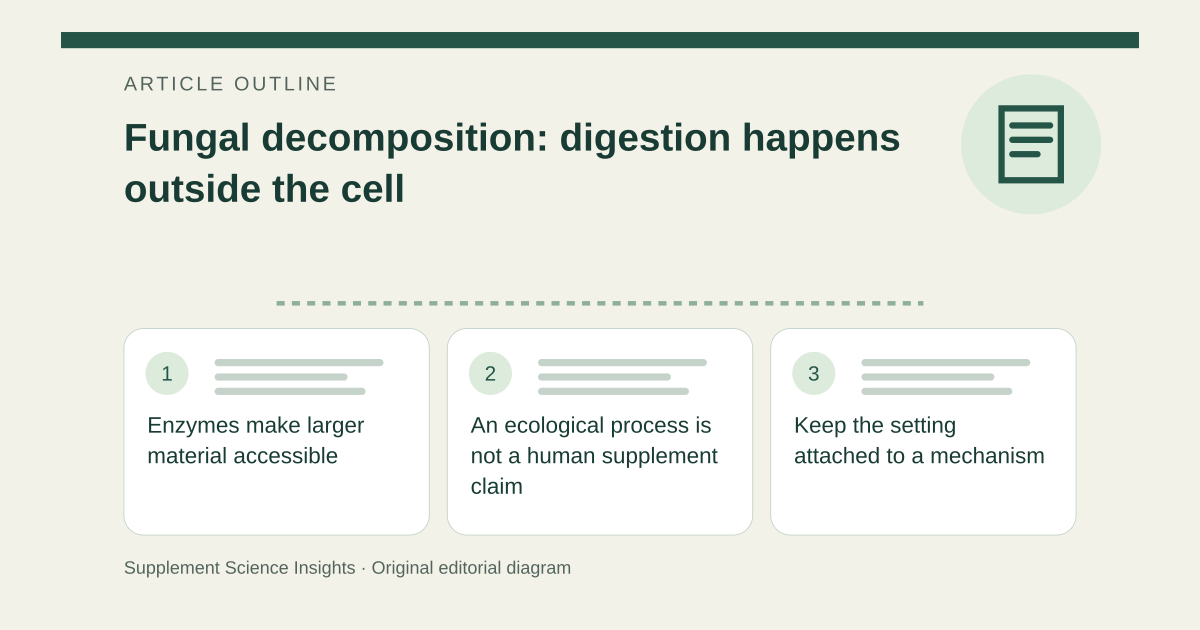
Enzymes make larger material accessible
A decomposer fungus does not swallow a piece of wood. Enzymes released into its surroundings, or attached near its cell surface, break larger compounds into smaller molecules that can be transported into fungal cells. [1]
This activity returns elements from dead material to ecological nutrient cycles. Water supports the movement of enzymes and dissolved molecules, which helps explain the importance of moisture to active decomposition. [1]
An ecological process is not a human supplement claim
The explanation concerns saprotrophic fungi in their environment. It does not mean every mushroom species decomposes the same substrate or that eating a fungal extract produces a comparable cleaning process inside a person. [1]
The source is a biology textbook, not a trial of a digestive or detoxification supplement. To evaluate such a product, evidence would need to identify its composition and a measured human outcome rather than relying on the organism’s role in a forest. [1]
Keep the setting attached to a mechanism
Imagine a fungus breaks down a compound in decaying wood. That does not establish that a capsule made from it performs the same reaction in the human digestive tract.
| Detail | Interpretation |
|---|---|
| External enzymes | Break down surrounding material |
| Cell transport | Takes up smaller molecules |
| Ecosystem role | Not a clinical benefit claim |
Sources for this article
- 24.3 Ecology of Fungi - Biology 2e | OpenStax
Source consulted: 2026-09-19. This is a reference resource, not a claim that we conducted the studies or tested a product.