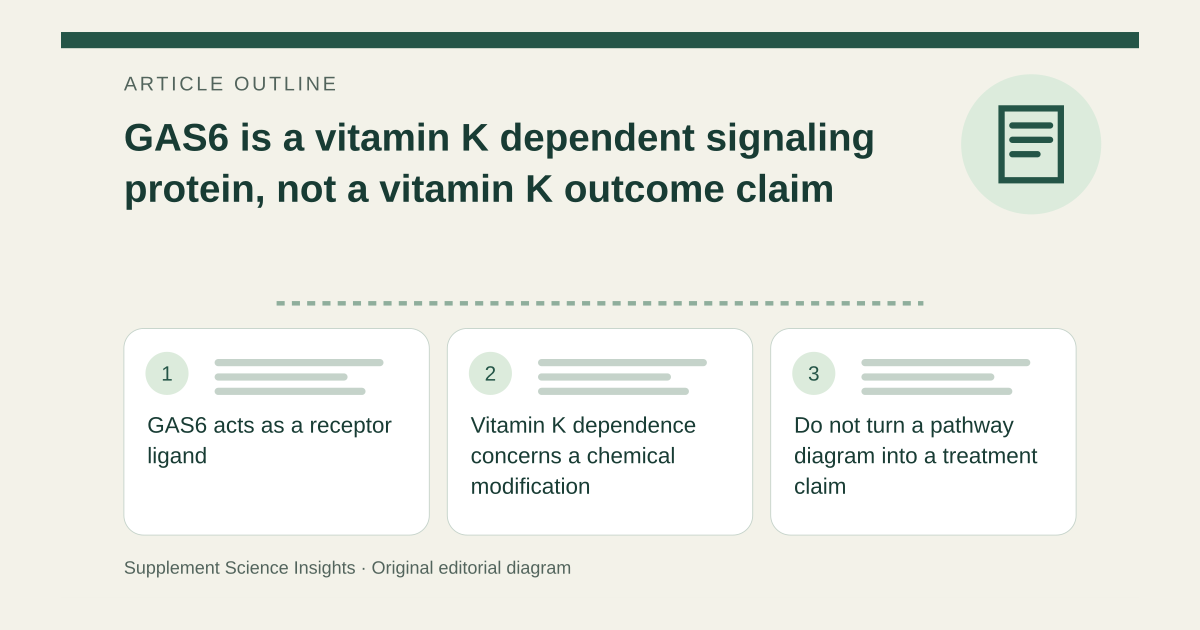
GAS6 acts as a receptor ligand
The curated human UniProt entry identifies GAS6 as a ligand for AXL, TYRO3 and MER receptor tyrosine kinases. These signaling systems participate in processes including cell survival, adhesion and migration. [1]
GAS6 is a protein signal. The name does not identify a vitamin formulation or a clinical endpoint. [1]
Vitamin K dependence concerns a chemical modification
UniProt describes vitamin K dependent formation of gamma-carboxyglutamate residues, which are needed for calcium binding. This is a post-translational change to the protein. [1]
A required biochemical process is not a dose-response trial. The entry does not show that raising supplemental vitamin K improves a disease by increasing GAS6 activity. [1]
Do not turn a pathway diagram into a treatment claim
Imagine a diagram connects vitamin K to GAS6 modification. That connection explains a mechanism; it does not supply a tested supplement dose or patient benefit.
| Detail | Interpretation |
|---|---|
| GAS6 | Signaling protein |
| Vitamin K dependence | Carboxylation chemistry |
| Extra supplementation | Benefit not established by mechanism |
Sources for this article
- gas6-uniprot
Source consulted: 2026-09-18. This is a reference resource, not a claim that we conducted the studies or tested a product.