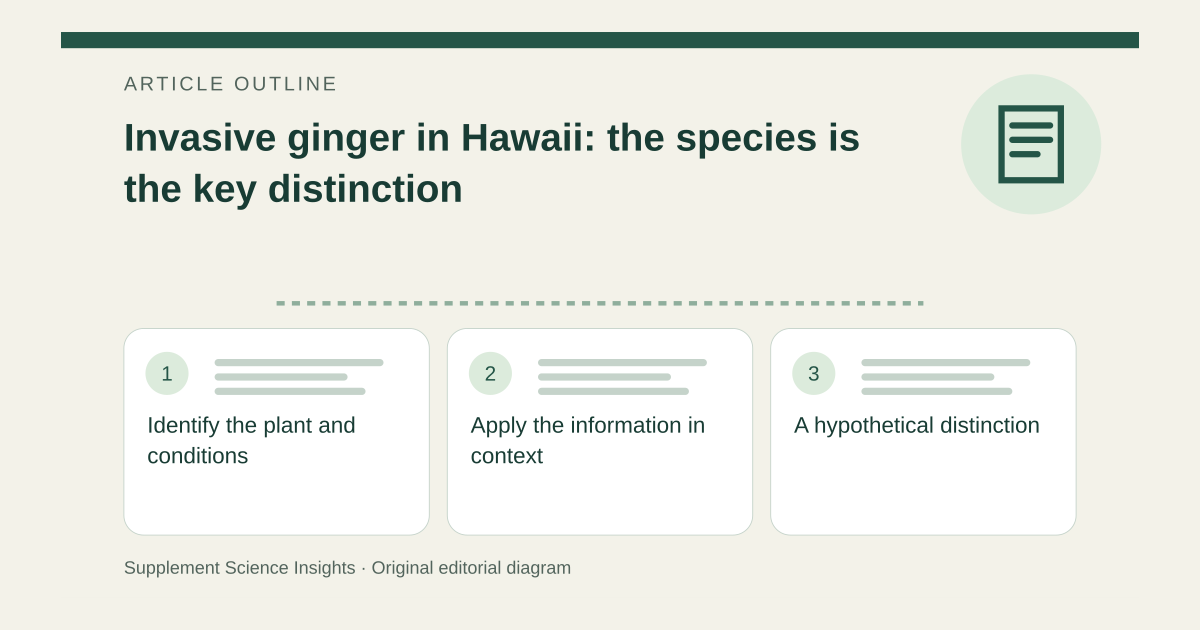
Identify the plant and conditions
The Hawaii Invasive Species Council describes Hedychium gardnerianum as a serious forest invader. Dense rhizome mats and shade-tolerant thickets can occupy the understory and interfere with native seedling establishment. [1]
The plant originated outside Hawaii and was introduced horticulturally. Its local name, kahili ginger, does not make it a native Hawaiian species. [1]
Apply the information in context
Invasive impact depends on the organism and receiving ecosystem. The evidence here concerns this species in affected regions, not a blanket classification of culinary ginger or all ornamental relatives. Local guidance should inform planting and handling decisions. [1]
A hypothetical distinction
Imagine a familiar local common name develops after an introduced plant becomes widespread. Familiarity and long presence still do not establish that the species is native.
| Detail | Interpretation |
|---|---|
| Hedychium gardnerianum | Problem species |
| Dense understory growth | Ecological mechanism |
| Common name | Not native-status evidence |
Sources for this article
- THE TARGET: HIMALAYAN (KAHILI) GINGER (HEDYCHIUM GARDNERIANUM) – Hawaii Invasive Species Council
Source consulted: 2026-09-19. This is a reference resource, not a claim that we conducted the studies or tested a product.