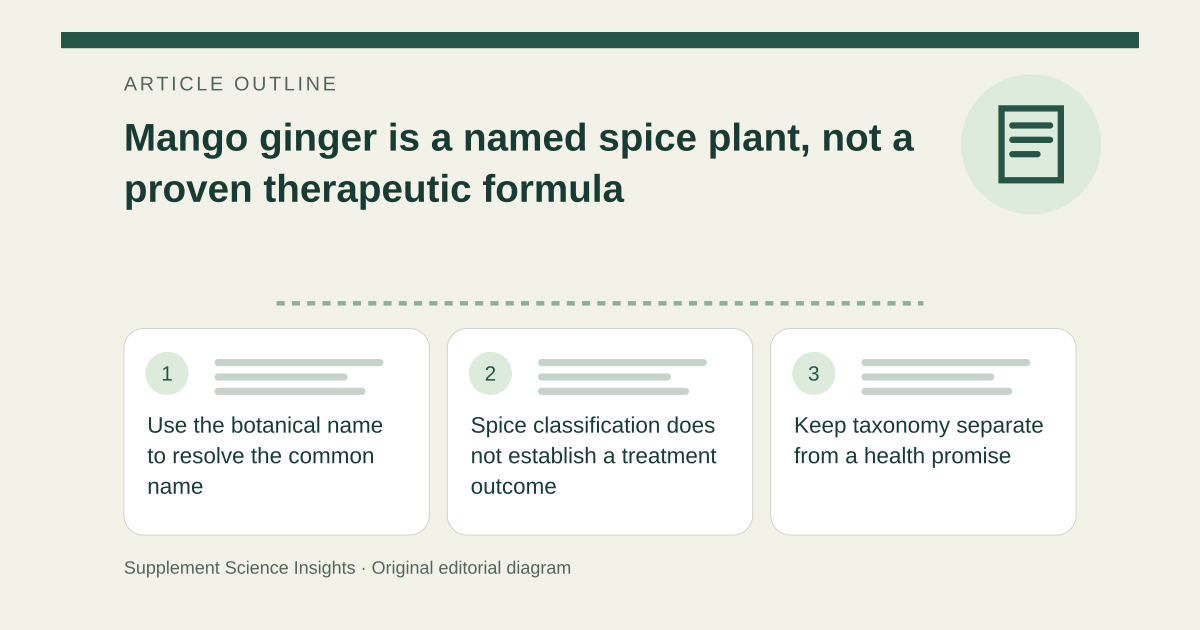
Use the botanical name to resolve the common name
The spice program identifies mango ginger, also called Amba Haldi, as Curcuma amada. Kew recognizes the species in the family Zingiberaceae and places it in the genus Curcuma. [1][2]
A common name containing ginger should therefore not be used alone to match it to a study of a different plant or extract. [1][2]
Spice classification does not establish a treatment outcome
Its inclusion among spice crops supports a culinary ingredient identity. The cited crop and taxonomy records do not test whether a capsule relieves a symptom or improves a disease outcome. [1][2]
For a health claim, look for research on the same species, plant part, preparation and route. A food-use description cannot supply a supplement dose or prove that concentrated use is equally well tolerated. [1][2]
Keep taxonomy separate from a health promise
Imagine a package correctly identifies C. amada but promises a medical benefit using a study of another ginger-family species. Correct labeling does not fix the mismatched evidence.
| Detail | Interpretation |
|---|---|
| Mango ginger | C. amada in the crop inventory |
| Spice use | Ingredient context |
| Therapeutic claim | Needs separate clinical evidence |
Sources for this article
- ICAR-AICRP on Spices
Source consulted: 2026-09-18. This is a reference resource, not a claim that we conducted the studies or tested a product. - Curcuma amada Roxb. | Plants of the World Online | Kew Science
Source consulted: 2026-09-18. This is a reference resource, not a claim that we conducted the studies or tested a product.