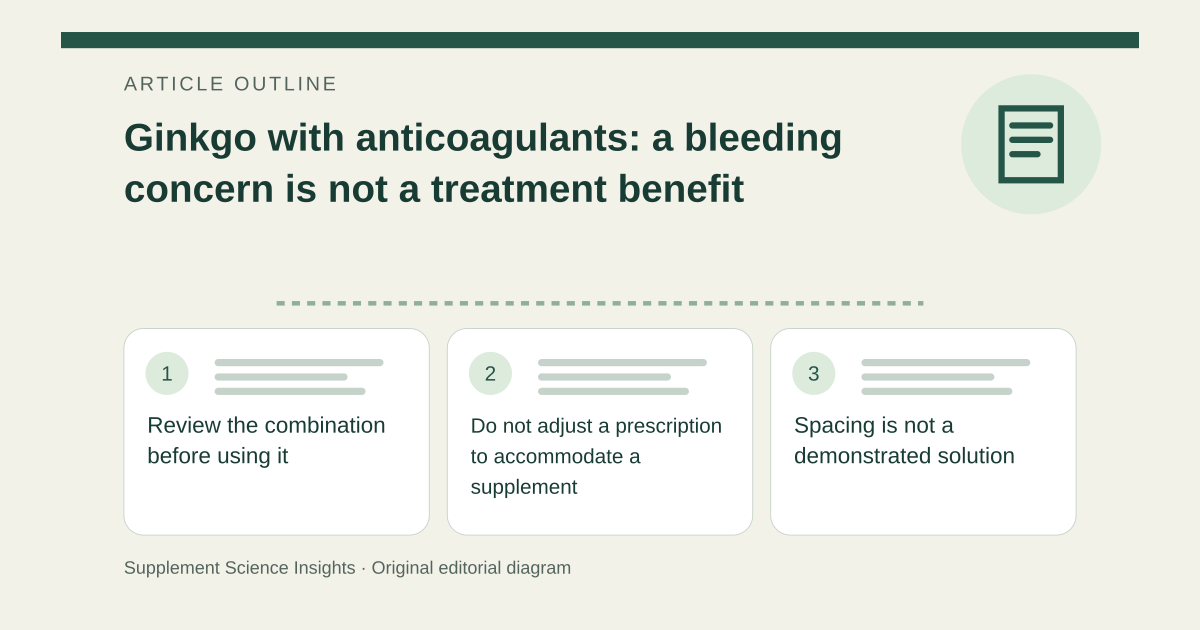
Review the combination before using it
NCCIH specifically flags possible increased bleeding with anticoagulant medicines and notes that ginkgo can interact with other drugs. Bring the complete supplement formula and medication list to the prescriber or pharmacist. [1]
The phrase thins the blood is too imprecise to establish a dose, a predictable effect or a safe combination. A potential adverse interaction is not evidence of a desirable therapeutic effect. [1]
Do not adjust a prescription to accommodate a supplement
Do not replace or reduce prescribed anticoagulation on the assumption that ginkgo provides an equivalent effect. The evidence cited here does not establish such equivalence or a timing interval that makes the combination safe. [1]
A product containing several herbs also needs review as a whole. Findings about one ingredient do not clear the other components or their combined exposure. [1]
Spacing is not a demonstrated solution
Imagine someone takes warfarin in the evening and proposes ginkgo in the morning. Different clock times alone do not demonstrate that the bleeding concern has been removed; the combination still needs clinical review.
| Detail | Interpretation |
|---|---|
| Warfarin plus ginkgo | Potential bleeding concern |
| Different times | Not proof of safety |
| Prescription changes | Require the treating team |
Sources for this article
- Ginkgo: Usefulness and Safety | NCCIH
Source consulted: 2026-09-17. This is a reference resource, not a claim that we conducted the studies or tested a product.