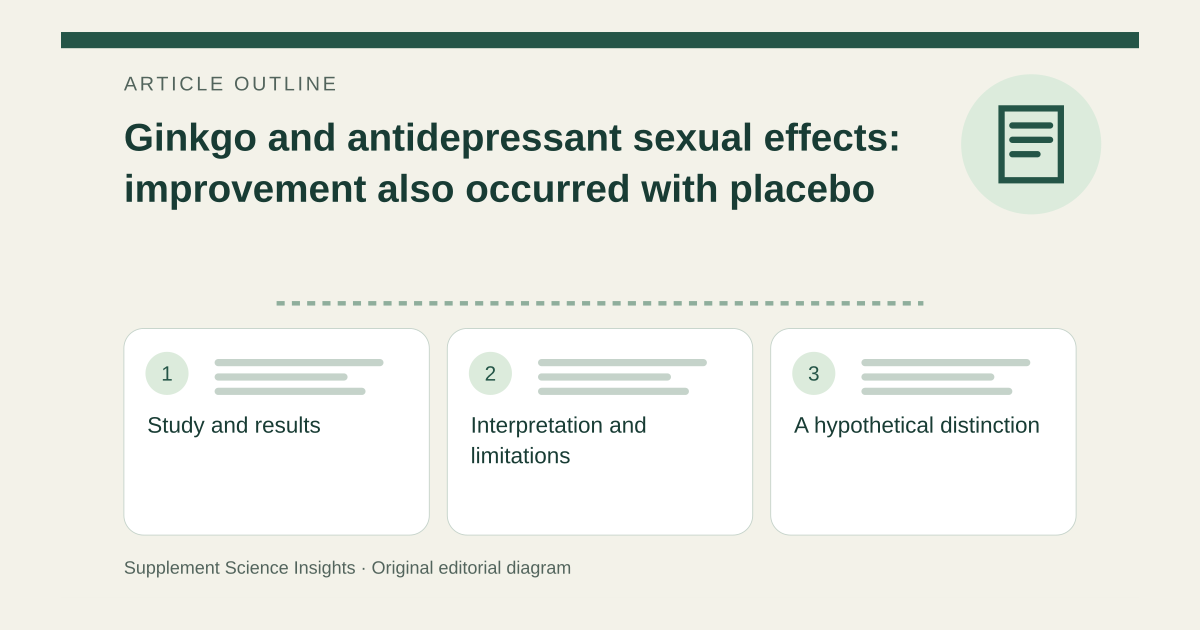
Study and results
Thirty-seven participants received ginkgo or placebo for two months in a double-blind study. Investigators compared outcomes at weeks two, four and eight. [1]
The groups did not differ significantly at those assessments. Both showed improvement in some aspects of sexual function compared with baseline, illustrating why a control group matters. [1]
Interpretation and limitations
The small study cannot settle every sexual-health question or every preparation, but it did not replicate an earlier positive finding. Funding and conflicts were not established from the abstract. The findings do not justify stopping prescribed treatment or assuming that a botanical will reverse its adverse effects. [1]
A hypothetical distinction
Imagine both treatment and placebo groups improve by similar amounts. Reporting only the active group’s change would overstate evidence that the treatment caused improvement.
| Detail | Interpretation |
|---|---|
| Baseline change | Not a treatment comparison |
| Placebo comparison | No significant difference |
| Other preparations | Not established |
Sources for this article
- A placebo-controlled, double-blind trial of Ginkgo biloba for antidepressant-induced sexual dysfunction - PubMed
Source consulted: 2026-09-19. This is a reference resource, not a claim that we conducted the studies or tested a product.