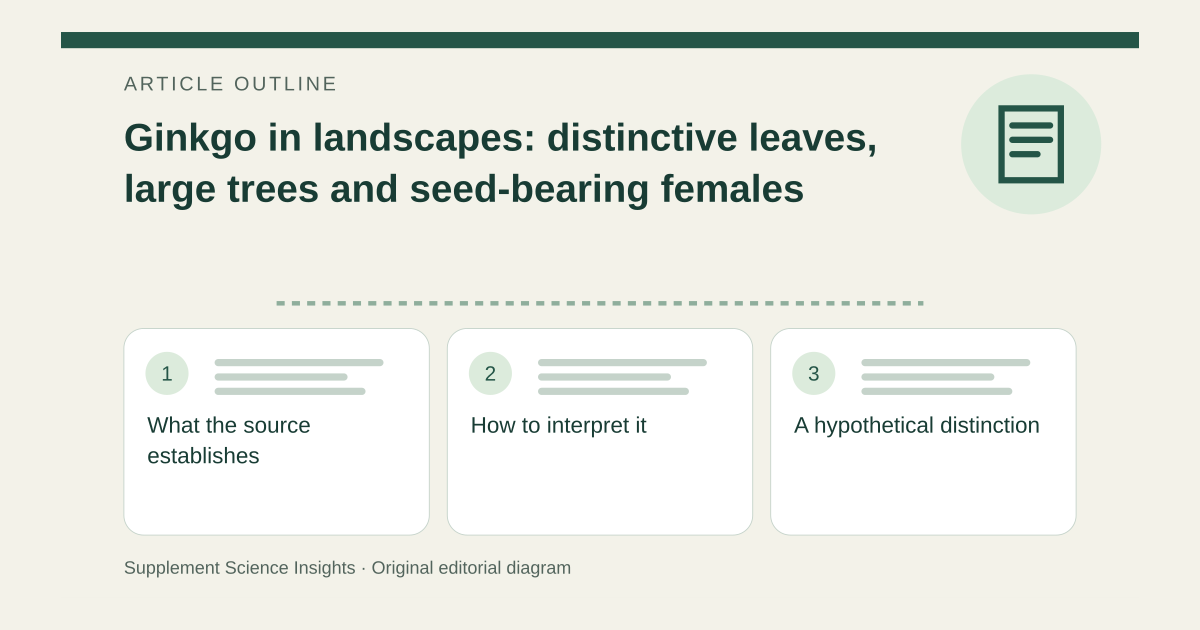
What the source establishes
NC State Extension describes fan-shaped, often two-lobed leaves and a mature tree that can become large. Leaves turn yellow in autumn; dwarf and narrow cultivars provide different growth forms. [1]
The profile recommends full sun and good drainage and describes tolerance of several urban stresses. Female trees produce fleshy, foul-smelling seeds, which is why grafted male trees are often chosen for streets and walkways. [1]
How to interpret it
Tolerance is not immunity to unsuitable conditions: the profile advises avoiding wet soils. Cultivar identity also matters for space planning. Neither a tree’s ancient lineage nor its ability to grow in cities establishes the effectiveness or safety of a leaf preparation. [1]
A hypothetical distinction
Imagine a small nursery tree is placed beside a narrow path. Its cultivar and eventual spread matter more for that choice than its current height.
| Detail | Interpretation |
|---|---|
| Cultivar | Expected growth form |
| Seed-bearing tree | Maintenance consideration |
| Landscape success | Not supplement evidence |
Sources for this article
- Ginkgo - Ginkgo biloba
|
North Carolina Extension Gardener Plant Toolbox
Source consulted: 2026-09-19. This is a reference resource, not a claim that we conducted the studies or tested a product.