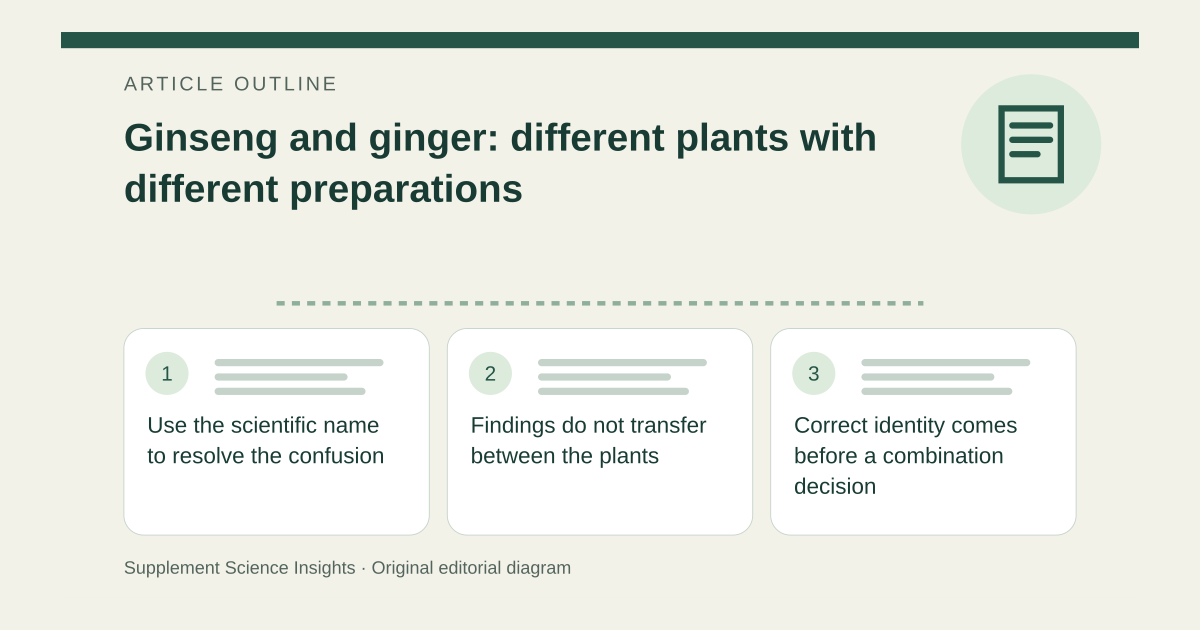
Use the scientific name to resolve the confusion
Asian ginseng commonly uses the root of Panax ginseng. Ginger uses the rhizome, an underground stem, of Zingiber officinale. They are not alternative spellings or processing forms of one plant. [1][2]
Even ginseng requires further identification: Asian ginseng is one type, and red and white Asian ginseng refer to different preparations. A label naming only a common category can leave relevant identity details unresolved. [1][2]
Findings do not transfer between the plants
NCCIH discusses ginger research for questions including nausea, while the Asian ginseng overview discusses fatigue, cognition and other distinct uses. A positive finding for ginger cannot be cited to support a ginseng product merely because the names sound alike. [1][2]
The same applies within a plant category. An extract, food preparation and multi-herb formula can create different exposures. Preserve the actual material and outcome when reading a study. [1][2]
Correct identity comes before a combination decision
Check the complete ingredient list, scientific name and preparation before considering effects or interactions. Combining the two does not establish complementary benefits, and one should not be substituted for the other in a clinical claim. [1][2]
Food traditions and supplement studies also serve different purposes. This identity comparison is not a recommendation to use either plant for a condition. [1][2]
A spelling error can import the wrong evidence
Imagine a research note changes ginger to ginseng while leaving a nausea-study citation in place. The citation no longer supports the named ingredient. Correct identification is necessary before any dose or effect comparison.
| Question | Relevant distinction |
|---|---|
| Panax ginseng | Asian ginseng |
| Zingiber officinale | Ginger |
| Similar name | No equivalence of evidence |
Sources for this article
- NCCIH: Asian Ginseng
Source consulted: 2026-09-17. This is a reference resource, not a claim that we conducted the studies or tested a product. - NCCIH: Ginger
Source consulted: 2026-09-17. This is a reference resource, not a claim that we conducted the studies or tested a product.