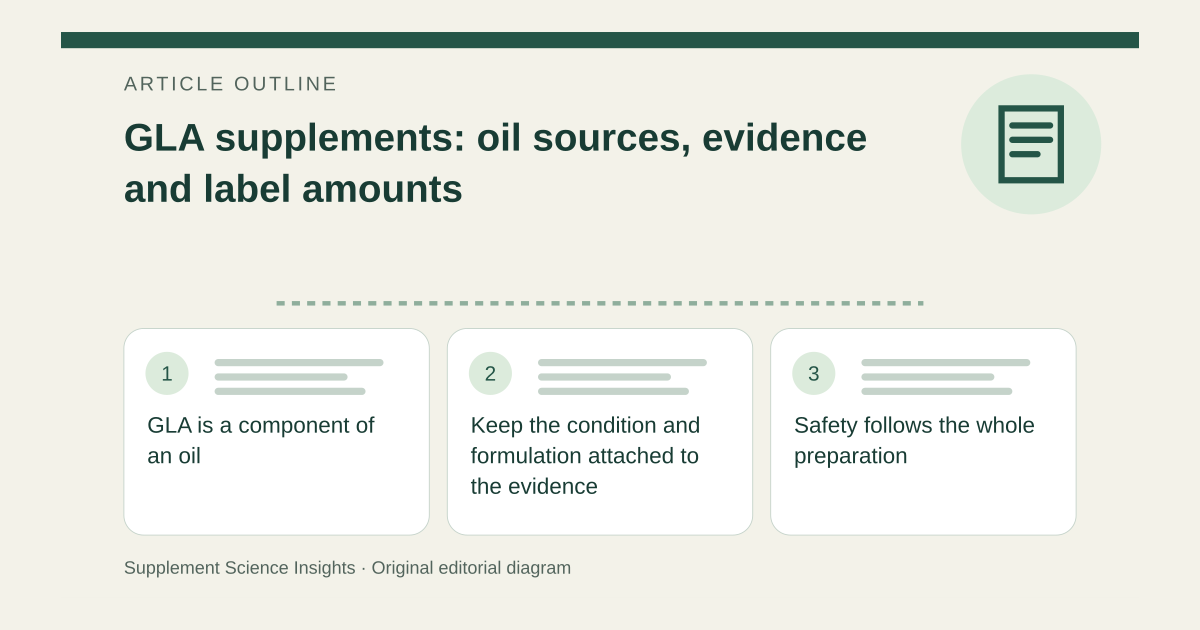
GLA is a component of an oil
NCCIH identifies evening primrose oil as an omega-6 source containing GLA and lists borage and black currant oils among GLA-containing supplements. A capsule labeled with an oil’s total weight need not contain that weight of GLA. Look for a separate declared GLA amount or concentration. [1][2]
Keep the condition and formulation attached to the evidence
NCCIH describes possible rheumatoid-arthritis symptom benefits from GLA oils but emphasizes the small number of studies for each oil. Its current evening-primrose summary finds insufficient evidence to support that oil for health conditions overall. These summaries do not establish a universally effective GLA dose or justify replacing rheumatoid-arthritis care. [2][1]
Safety follows the whole preparation
Evening primrose oil can cause abdominal discomfort, nausea or diarrhea, and medicines should be reviewed before use. Those observations are about that oil, not a complete safety assessment of borage, black currant or a blend. Check all ingredients rather than treating GLA as the entire product. [1][3]
Calculate GLA separately from capsule weight
Imagine a label declares 1,000 mg oil standardized to 10% GLA. That corresponds to 100 mg GLA, assuming the percentage applies to the declared oil mass. It does not correspond to 1,000 mg GLA, and the calculation does not establish a treatment dose. [2]
| Label item | Amount |
|---|---|
| Total oil | 1,000 mg |
| GLA fraction | 10% |
| Calculated GLA | 100 mg |
Sources for this article
- Evening Primrose Oil: Usefulness and Safety | NCCIH
Source consulted: 2026-09-20. This is a reference resource, not a claim that we conducted the studies or tested a product. - 6 Things To Know About Complementary Health Approaches for Rheumatoid Arthritis | NCCIH
Source consulted: 2026-09-20. This is a reference resource, not a claim that we conducted the studies or tested a product. - Dietary Supplements: What You Need to Know
Source consulted: 2026-09-20. This is a reference resource, not a claim that we conducted the studies or tested a product.